MCQ
In the given reaction:

$\begin{array}{*{20}{c}}
  {O\,\,\,\,} \\ 
  {||\,\,\,\,} \\ 
  {C{H_3} - CH - C - C{H_2} - C{H_3}} \\ 
  {|\,\,\,\,\,\,\,\,\,\,\,\,\,\,\,\,\,\,\,\,\,\,\,\,\,\,\,\,\,\,\,\,\,\,\,\,\,\,\,\,\,} \\ 
  {C{H_3}\,\,\,\,\,\,\,\,\,\,\,\,\,\,\,\,\,\,\,\,\,\,\,\,\,\,\,\,\,\,\,\,\,\,\,} 
\end{array}\xrightarrow{{C{F_3}COOOH}}[X]$ as main product

$[X]$ will be :

  • $\begin{array}{*{20}{c}}
      {O\,\,\,\,\,\,\,\,\,\,} \\ 
      {||\,\,\,\,\,\,\,\,\,\,} \\ 
      {C{H_3} - C{H_2} - C - O - CH - C{H_3}} \\ 
      {\,\,\,\,\,\,\,\,\,\,\,\,\,\,\,\,\,\,\,\,\,\,\,\,\,\,\,\,\,\,\,\,\,\,\,\,\,|} \\ 
      {\,\,\,\,\,\,\,\,\,\,\,\,\,\,\,\,\,\,\,\,\,\,\,\,\,\,\,\,\,\,\,\,\,\,\,\,\,\,\,\,\,\,C{H_3}} 
    \end{array}$
  • B
    $\begin{array}{*{20}{c}}
      {O\,\,\,\,\,\,\,\,\,\,\,\,} \\ 
      {||\,\,\,\,\,\,\,\,\,\,\,\,\,\,} \\ 
      {C{H_3} - CH - C - O - C{H_2} - C{H_3}} \\ 
      {|{\kern 1pt} \,\,\,\,\,\,\,\,\,\,\,\,\,\,\,\,\,\,\,\,\,\,\,\,\,\,\,\,\,\,\,\,\,\,\,\,\,\,\,\,\,\,\,\,\,\,\,\,\,\,} \\ 
      {C{H_3}\,\,\,\,\,\,\,\,\,\,\,\,\,\,\,\,\,\,\,\,\,\,\,\,\,\,\,\,\,\,\,\,\,\,\,\,\,\,\,\,\,\,} 
    \end{array}$
  • C
    $\begin{array}{*{20}{c}}
      {O\,\,\,\,\,\,\,\,\,\,\,\,\,\,\,} \\ 
      {||\,\,\,\,\,\,\,\,\,\,\,\,\,\,\,\,\,} \\ 
      {C{H_3} - C - OC{{(C{H_3})}_3}} 
    \end{array}$
  • D
    $(CH_3)_3COOCH_3$

Answer

Correct option: A.
$\begin{array}{*{20}{c}}
  {O\,\,\,\,\,\,\,\,\,\,} \\ 
  {||\,\,\,\,\,\,\,\,\,\,} \\ 
  {C{H_3} - C{H_2} - C - O - CH - C{H_3}} \\ 
  {\,\,\,\,\,\,\,\,\,\,\,\,\,\,\,\,\,\,\,\,\,\,\,\,\,\,\,\,\,\,\,\,\,\,\,\,\,|} \\ 
  {\,\,\,\,\,\,\,\,\,\,\,\,\,\,\,\,\,\,\,\,\,\,\,\,\,\,\,\,\,\,\,\,\,\,\,\,\,\,\,\,\,\,C{H_3}} 
\end{array}$
a

Need a full question paper?

Generate a complete, print-ready paper with questions like this in minutes — across 16+ boards, with answer keys.

Start Generating Free

Similar questions

The ratio of $\frac{{{C_p}}}{{{C_v}}}$ for inert gases is
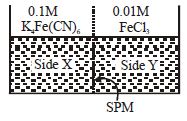
$FeCl_3$ on reaction with $K_4[Fe(CN)_6]$ in aqueous solution gives blue colour. These are separated by a semipermeable membrane $AB$ as shown. Due to osmosis there is
$PC{l_5}$ reacts with a compound containing
The concentration of an aqueous solution of $0.01\,M\,\,C{H_3}OH$ solution is very nearly equal to which of the following
The sum of oxidation states of two silver ions in $\left[\mathrm{Ag}\left(\mathrm{NH}_{3}\right)_{2}\right]\left[\mathrm{Ag}(\mathrm{CN})_{2}\right]$ complex is .... .
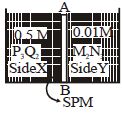
$0.5\,M$ , $P_3Q_2(i = 5)$ when reacted with $0.01\,M$ , $M_2N_3(i = 5)$ in aqueous solution gives brown colour. These are separated by a semipermeable membrane $AB$ as shown Due to osmosis there is
When phenol is reacted with $CHC{l_3}$ and $NaOH$ followed by acidification, salicyldehyde is obtained. Which of the following species are involved in the above mentioned reaction as inter mediate
For the reaction $C{H_3}COOC{H_3} + {H_2}O\xrightarrow{{{H^ + }}}$ $C{H_3}COOH + C{H_3}OH$ The progress of the process of reaction is followed by
An organic compound '$A$' contains nitrogen and chlorine. It dissolves readily in water to give a solution that turns litmus red. Titration of compound '$A$' with standard base indicates that the molecular weight of ' $A$ ' is $131\,\pm\,2$. When a sample of '$A$' is treated with aq. $NaOH$, a liquid separates which contains $N$ but not $Cl$. Treatment of the obtained liquid with nitrous acid followed by phenol gives orange precipitate. The compound '$A$' is.
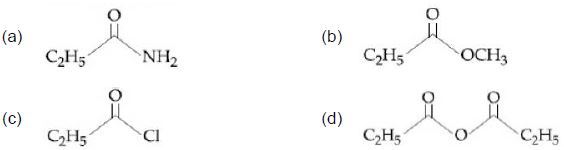
The increasing order of the reactivity of the following with $LiAlH_4$ is