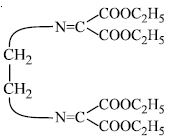
$NH_2-CH_2-CH_2-NH_2 +$ $\begin{array}{*{20}{c}}
{COO{C_2}{H_5}} \\
{|\,\,\,\,\,\,\,\,\,\,\,\,\,\,\,\,\,\,\,\,\,\,\,\,\,} \\
{COO{C_2}{H_5}}
\end{array}$ $\xrightarrow{{Pyridne}}$ $[X]$
$[X]$ will be :
- A
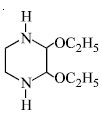
- ✓
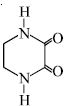
- C
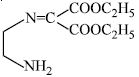
- D
$NH_2-CH_2-CH_2-NH_2 +$ $\begin{array}{*{20}{c}}
{COO{C_2}{H_5}} \\
{|\,\,\,\,\,\,\,\,\,\,\,\,\,\,\,\,\,\,\,\,\,\,\,\,\,} \\
{COO{C_2}{H_5}}
\end{array}$ $\xrightarrow{{Pyridne}}$ $[X]$
$[X]$ will be :


Generate a complete, print-ready paper with questions like this in minutes — across 16+ boards, with answer keys.
$Xe{F_6}\xrightarrow{{ + {H_2}O}}A\xrightarrow{{ + {H_2}O}}B\xrightarrow{{ + {H_2}O}}C$

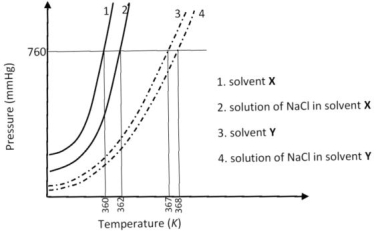
On addition of equal number of moles of a non-volatile solute $S$ in equal amount (in $kg$ ) of these solvents, the elevation of boiling point of solvent $X$ is three times that of solvent $Y$. Solute $S$ is known to undergo dimerization in these solvents. If the degree of dimerization is $0.7$ in solvent $Y$, the degree of dimerization in solvent $X$ is. . . . . . .