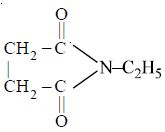
MCQ
In the given reaction sequence :

$\begin{array}{*{20}{c}}
  {C{H_2} - COOH} \\ 
  {|\,\,\,\,\,\,\,\,\,\,\,\,\,\,\,\,\,\,\,\,\,\,\,\,\,\,\,\,\,\,\,\,} \\ 
  {C{H_2} - COOH} 
\end{array}\xrightarrow{\Delta }(A)\xrightarrow{{C{H_3} - C{H_2}N{H_2}/\Delta }}(B)$

$(B)$ will be :

  • A
    $\begin{array}{*{20}{c}}
      {O\,\,\,\,\,\,\,\,\,\,\,\,\,\,\,\,\,\,} \\ 
      {||\,\,\,\,\,\,\,\,\,\,\,\,\,\,\,\,\,\,} \\ 
      {C{H_2} - C - NH - {C_2}{H_5}} \\ 
      {|\,\,\,\,\,\,\,\,\,\,\,\,\,\,\,\,\,\,\,\,\,\,\,\,\,\,\,\,\,\,\,\,\,\,\,\,\,\,\,\,\,\,\,\,\,\,\,\,\,\,\,\,\,\,\,\,\,\,\,\,} \\ 
      {C{H_2} - C - NH - {C_2}{H_5}} \\ 
      {||\,\,\,\,\,\,\,\,\,\,\,\,\,\,\,\,\,\,\,} \\ 
      \,\,\,\,{O\,\,\,\,\,\,\,\,\,\,\,\,\,\,\,\,\,\,\,} 
    \end{array}$

  • C
    $\begin{array}{*{20}{c}}
      {C{H_2} - COOH} \\ 
      {|\,\,\,\,\,\,\,\,\,\,\,\,\,\,\,\,\,\,\,\,\,\,\,\,\,\,\,\,\,\,\,\,\,\,\,\,\,\,} \\ 
      {C{H_2} - COOH} 
    \end{array}$
  • D
    $\begin{array}{*{20}{c}}
      \,\,\,\,{O\,\,\,\,\,\,\,\,\,\,\,\,\,\,\,\,\,\,\,\,\,} \\ 
      {||\,\,\,\,\,\,\,\,\,\,\,\,\,\,\,\,\,\,\,} \\ 
      {C{H_2} - C - NH - {C_2}{H_5}} \\ 
      {|\,\,\,\,\,\,\,\,\,\,\,\,\,\,\,\,\,\,\,\,\,\,\,\,\,\,\,\,\,\,\,\,\,\,\,\,\,\,\,\,\,\,\,\,\,\,\,\,\,\,\,\,\,\,\,\,\,\,\,\,} \\ 
     \,\,\,\, {C{H_2} - COOH\,\,\,\,\,\,\,\,\,\,\,\,\,\,\,\,\,\,\,\,\,\,\,\,\,\,\,} 
    \end{array}$
Answer

Correct option: B.

b

Need a full question paper?

Generate a complete, print-ready paper with questions like this in minutes — across 16+ boards, with answer keys.

Start Generating Free

Similar questions

Rosenmund reduction cannot be used for the preparation of
$2-$ Butanol $\xrightarrow[\Delta ]{{{H^ + }}}$ Products

If all products formed in the above reaction undergo reaction with $Br_2(CCl_4)$ individually then number of products formed will be :

In the following reaction

$\begin{matrix}
   \begin{matrix}
   C{{H}_{3}}\,\,\,\,\,\,\,\, \,\, \\
   |\,\,\,\,\,\,\,\,\,\,\,\,\,\,\,\,\,\,  \\
\end{matrix}  \\
   C{{H}_{3}}-C-CH=C{{H}_{2}}  \\
   |\,\,\,\,\,\,\,\,\,\,\,\,\,\,\,\,\,\,  \\
   C{{H}_{3}}\,\,\,\,\,\,\,\, \,\,\,\, \\
\end{matrix}\,$ $\xrightarrow{{{H}_{2}}O/{{H}^{\oplus }}}$ $\underset{Major\,\,product}{\mathop{A}}\,$ $+$ $\underset{Major\,\,product}{\mathop{B}}\,$

The major product is

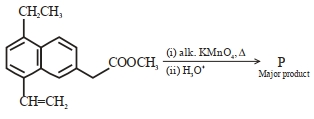
The major product ' $P$ ' formed in the given reaction is
In the experiment set up for the measurement of EMF of a half cell using a reference electrode and a salt bridge, when the salt bridge is removed, the voltage
The strongest acid amongst the following is
Given that $\frac{1}{3}\mathop {{\lambda _m}}\limits^\infty  \left( {F{e^{3 + }}} \right) = 68\,oh{m^{ - 1}}\,c{m^{ - 1}}\,e{q^{ - 1}}$ and $\frac{1}{2}\mathop {{\lambda _m}}\limits^\infty  \left( {SO_4^{2 - }} \right) = 80\,oh{m^{ - 1}}\,c{m^{ - 1}}\,e{q^{ - 1}}$ What will be value of $\mathop {{\lambda _{eq}}}\limits^\infty  \left( {F{e_2}{{\left( {S{O_4}} \right)}_3}} \right)$ ? ............ ${\rm{oh}}{{\rm{m}}^{ - 1}}{\mkern 1mu} {\rm{c}}{{\rm{m}}^2}$ $\mathrm{eq}^{-1}$
Which is most reactive for nucleophilic addition reaction
Among the given solutions which one has highest boiling point under similar condition?
______________ are found in nitrates, phosphates of metals.