Question
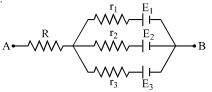
In the network shown the potential difference between $A$ and $B$ is ................. $V$ $(R = r_1 = r_2 = r_3 = 1 \Omega$ ,$ E_1 = 3\, V, E_2 = 2\, V, E_3 = 1\, V)$
Answer

b
No current through $R$, so potential difference across

$A B$ is$V=\frac{\frac{E_{1}}{r_{1}}+\frac{E_{2}}{r_{2}}+\frac{E_{3}}{r_{3}}}{\frac{1}{r_{1}}+\frac{1}{r_{2}}+\frac{1}{r_{3}}}=\frac{\frac{3}{1}+\frac{2}{1}+\frac{1}{1}}{\frac{1}{1}+\frac{1}{1}+\frac{1}{1}}=2 V$

Need a full question paper?

Generate a complete, print-ready paper with questions like this in minutes — across 16+ boards, with answer keys.
Start Generating Free

Similar questions

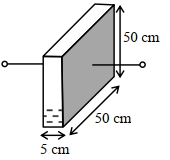
A container has a base of $50 \mathrm{~cm} \times 5 \mathrm{~cm}$ and height $50 \mathrm{~cm}$, as shown in the figure. It has two parallel electrically conducting walls each of area $50 \mathrm{~cm} \times 50 \mathrm{~cm}$. The remaining walls of the container are thin and non-conducting. The container is being filled with a liquid of dielectric constant $3$ at a uniform rate of $250 \mathrm{~cm}^3 \mathrm{~s}^{-1}$. What is the value of the capacitance of the container after $10$ seconds? [Given: Permittivity of free space $\epsilon_0=9 \times 10^{-12} \mathrm{C}^2 \mathrm{~N}^{-1} \mathrm{~m}^{-2}$, the effects of the non-conducting walls on the capacitance are negligible]
If $| A + B |=| A |+| B |$ the angle between $\overrightarrow A $and $\overrightarrow B $ is $ ....... $
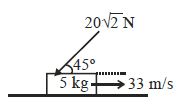
A block of mass $5\, kg$ is kept on a rough horizontal floor. It is given a velocity $33\, m/s$ towards right. A force of $20\sqrt {2\,} \,N$ continuously acts on the block as shown in the figure. If the coefficient of friction between block and floor is $0.5$ the velocity of block after $3\, seconds$ is ........ $m/s$  ($g = 10\, m/s^2$)
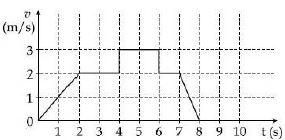
A particle starts from the origin at time $t = 0$ and moves along the positive $x-$ axis. The graph of velocity with respect to time is shown in figure. What is the position of the particle at time $t = 5 s\ ?.........m$
The internal energy change in a system that has absorbed $2 \;k cal$ of heat and done $500 \;J $ of work is ...... $J$
One mole of an ideal monoatomic gas undergoes the following four reversible processes:

Step $1$ It is first compressed adiabatically from volume $8.0 \,m ^{3}$ to $1.0 \,m ^{3}$.

Step $2$ Then expanded isothermally at temperature $T_{1}$ to volume $10.0 \,m ^{3}$.

Step $3$ Then expanded adiabatically to volume $80.0 \,m ^{3}$.

Step $4$ Then compressed isothermally at temperature $T_{2}$ to volume $8.0 \,m ^{3}$.

Then, $T_{1} / T_{2}$ is

An air bubble of volume $1\,cm ^3$ rises from the bottom of a lake $40\,m$ deep to the surface at a temperature of $12^{\circ}\,C$. The atmospheric pressure is $1 \times 10^5 Pa$, the density of water is $1000\,kg / m ^3$ and $g =10\,m / s ^2$. There is no difference of the temperature of water at the depth of $40\,m$ and on the surface. The volume of air bubble when it reaches the surface will be $..........\,cm^{3}$
A milliammeter of range $10\, mA$ has a coil of resistance $1 \,\Omega$. To use it as voltmeter of range $10\, volt$, the resistance that must be connected in series with it, will be ............. $\Omega $
The focal length of a concave mirror is $50 \,cm.$ Where an object be placed so that its image is two times and inverted.......$cm$
In a two slit experiment with monochromatic light fringes are obtained on a screen placed at some distance from the sits. If the screen is moved by $5 \times {10^{ - 2}}m$ towards the slits, the change in fringe width is $3 \times {10^{ - 5}}m$. If separation between the slits is ${10^{ - 3}}m$, the wavelength of light used is.........$\mathop A\limits^o $