MCQ
In the reaction :$I_2 + 2S_2O_3^{2-} \to 2I^- + S_4O_6^{2-}$
  • A
    $I_2$ is reducing agent.
  • $I_2$ is oxidising agent and $S_2O_3^{2-}$ is reducing agent.
  • C
    $S_2O_3^{2-}$ is oxidising agent.
  • D
    $I_2$ is reducing agent and $S_2O_3^{2-}$ is oxidising agent.

Answer

Correct option: B.
$I_2$ is oxidising agent and $S_2O_3^{2-}$ is reducing agent.
b
$\stackrel{0}{I}_2 \rightarrow \stackrel{0^{-}}{2I}$

$I _2$ undergoes reduction hence acts as oxidising agents.

$S _2^{+2} O _6^{2-} \rightarrow S _4^{+2.5} O _6^{2-}$

It undergoes oxidation hence acts as a reducing agent.

Need a full question paper?

Generate a complete, print-ready paper with questions like this in minutes — across 16+ boards, with answer keys.

Start Generating Free

Similar questions

Consider the following statements:

$(A)$ The principal quantum number $'n'$ is a positive integer with values of $'n'=1,2,3, \ldots$.

$(B)$ The azimuthal quantum number $'l'$ for a given $'n'$ (principal quantum number) can have values as $'l'=0,1,2, \ldots n$

$(C)$ Magnetic orbital quantum number $'m _{l}'$ for a particular $'l'$ (azimuthal quantum number) has $(2 l$ + 1) values.

$(D)$ $\pm 1 / 2$ are the two possible orientations of electron spin.

$(E)$ For $l=5$, there will be a total of $9$ orbital.

Which of the above statements are correct?
The hybridizations of atomic orbitals of nitrogen in $NO_2^+, NO_3^-$ and $NH_4^+$ respectively are
Based on equation $E = -2.178 \times 10^{-18}\, J \,\frac{Z^2}{n^2}$ certain conclusions are written. Which of them is not correct ?
Which of the following sets of quantum numbers are correct?
 
n
l
ml
a.
1
1
+2
b.
2
1
+1
c.
3
2
-2
d.
3
4
-2
Which of the following products is formed when $n-$ heptane is passed over $(Al_2O_3 + Cr_2O_3)$ catalyst at $773\,K$ ?
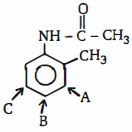
Identify the position where electrophilic aromatic substitution $(EAS)$ is most  favourable.
A mixture of two moles of carbon monoxide and one mole of oxygen, in a closed vessel is ignited to convert the carbon monoxide to carbon dioxide. If $\Delta H$ is the enthalpy change and $\Delta E$ is the change in internal energy, then
If electron moves from an excited state to ground state in multistep in hydrogen spectrum lines in visible region are $4$. Then number of lines in infra red region is
The compound($s$) which react($s$) with $NH _3$ to give boron nitride ($BN$) is(are)

$(A)$ $B$ $(B)$ $B _2 H _6$ $(C)$ $B _2 O _3$ $(D)$ $HBF _4$

Amongst the following which one will have maximum 'lone pair - lone pair' electron repulsions?