MCQ
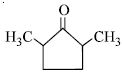
In the reaction sequence, $[X]$ is ketone :

$[X]$ $\xrightarrow{{KMn{O_4}/\mathop O\limits^\Theta  H/\Delta }}$ $\begin{array}{*{20}{c}}
  {\begin{array}{*{20}{c}}
  {\begin{array}{*{20}{c}}
  {\,\,\,\,\,\,\,\,\,\,\,\,\,\,\,\,\,\,\,\,\,\,\,\,\,\,\,\,C{H_3}} \\ 
  {\,\,\,\,\,\,\,\,\,\,\,\,\,\,\,\,\,\,\,\,\,|} \\ 
  {HOOC - {{(C{H_2})}_3} - CH - COOH} 
\end{array}} 
\end{array}} 
\end{array}$

$[X]$ will be:

  • A


  • C

  • D

Answer

Correct option: B.

b

Need a full question paper?

Generate a complete, print-ready paper with questions like this in minutes — across 16+ boards, with answer keys.

Start Generating Free

Similar questions

Fehling solution is
Among the following, which is the strongest oxidizing agent ?
Which of the following is an example of liquid dishwashing detergent?
 ${H_3}C - \mathop {\mathop {C{\mkern 1mu} {\mkern 1mu}  - {\mkern 1mu} }\limits_{|{\kern 1pt} {\kern 1pt} {\kern 1pt} {\kern 1pt} {\kern 1pt} {\kern 1pt} \,\,\,{\kern 1pt} {\kern 1pt} {\kern 1pt} }^{|{\kern 1pt} {\kern 1pt} {\kern 1pt} \,\,\,{\kern 1pt} {\kern 1pt} {\kern 1pt} {\kern 1pt} {\kern 1pt} {\kern 1pt} } }\limits_{C{H_{3\,\,\,}}}^{C{H_3}\,\,\,} Br + KOH(Aq.) \to {H_3}C - \mathop {\mathop {C{\mkern 1mu} {\mkern 1mu}  - {\mkern 1mu} }\limits_{|{\kern 1pt} {\kern 1pt} {\kern 1pt} {\kern 1pt} {\kern 1pt} {\kern 1pt} \,\,\,{\kern 1pt} {\kern 1pt} {\kern 1pt} }^{|{\kern 1pt} {\kern 1pt} \,\,\,{\kern 1pt} {\kern 1pt} {\kern 1pt} {\kern 1pt} {\kern 1pt} {\kern 1pt} {\kern 1pt} } }\limits_{C{H_{3\,\,\,}}}^{C{H_{3\,\,\,}}} OH + KBr$   above reaction is
At $298\,K$, a 1 litre solution containing $10\,m\,mol$ of $Cr _2 O _7{ }^{2-}$ and $100\,m\,mol$ of $Cr ^{3+}$ shows a $pH$ of $3.0$.

Given : $Cr _2 O _7^{2-} \rightarrow Cr ^{3+} ; E ^0=1.330\,V$ and

$\frac{2.303 RT }{ F }=0.059\,V$

The potential for the half cell reaction is $x \times 10^{-3}\,V$. The value of $x$ is $........$

When chlorine is passed through warm benzene in presence of the sunlight, the product obtained is
The correct $IUPAC$ name for the compound $[CO(NH_3)_4Cl(ONO]Cl$ is
$NO_2$ required for a reaction is produced by the decomposition of $N_2O_5$ in $CCl_4$ as per the equation  $2N_2O_5 (g) \to 4NO_2 (g) + O_2 (g)$ The initial concentration of $N_2O_5$ is $3.00\, mol\, L^{-1}$ and it is $2.75\, mol\, L^{-1}$ after $30\, minutes$. The rate of formation of $NO_2$ is ............... $mol\, L^{-1}\, min^{-1}$
From the following which is not an emulsifer?
Which of the following compounds does not react with $NaN{O_2}$ and $HCl$