MCQ
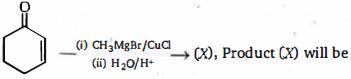
In the reaction sequence
- A

- ✓

- C

- D
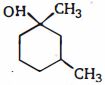
Organocopper reagents undergo conjugate addition:
The copper works by transmetallating the Grignard reagent to give an organocopper reagent. Organocoppers are softer than Grignard reagents, and add in a conjugate fashion to the softer $C = C$ double bond. Once the organocopper had added, the copper salt is available to transmetallate some more Grignard, and only a catalytic amount is required.
Generate a complete, print-ready paper with questions like this in minutes — across 16+ boards, with answer keys.
$A.6{H_2}{O_{\left( s \right)}} \rightleftharpoons A.2{H_2}{O_{(s)}} + \mathop {4{H_2}{O_{(g)}}};{{K_P} = 1.6 \times {{10}^{ - 11}}} $
$B.12{H_2}{O_{\left( s \right)}} \rightleftharpoons B.7{H_2}{O_{(s)}} + \mathop {5{H_2}{O_{(g)}}};{{K_P} = 2.43 \times {{10}^{ - 13}}} $
$B.10{H_2}{O_{\left( s \right)}} \rightleftharpoons {C_{(s)}} + \mathop {10{H_2}{O_{(g)}}};{{K_P} = {{10}^{ - 30}}} $
Aqueous tension of $H_2O$ at $0\,^oC$ is given as $0.76\ torr$
$(I)$ The most effective drying agent will be $C_{(s)}$. Out of $C_{(s)}$ , $B. 7H_2O_{(s)}$ & $A. 2H_2O_{(s)}$
$(II)$ At $0\,^oC$, $A.6H_2O_{(s)}$ & $B.12H_2O_{(s)}$ will
$(III)$ If $R.H$ is less than $100\%$ in a chamber at $0\,^oC$, then none of the substance can act as deliquescent
Which response contains all the correct statement about this process ?
$(1)$ Dehydration $(2)\, E_2$ mechanism
$(3)$ Carbon skeleton migration $(4)$ Most stable alkene will form
$(5)$ Single-step reaction
$(I)\,\,CH_3CH_2OH + HCl \xrightarrow{{Anh.\,\,ZnC{l_2}}}$
$(II)\,\,CH_3CH_2OH + HCl \rightarrow$
$(III)\,\,(CH_3)_3COH + HCl \rightarrow$
$(IV)\,\,(CH_3)_2CHOH + HCl \xrightarrow{{Anh.\,\,ZnC{l_2}}}$
$(I) 0.5\ mole$ of $O_3$ $(II) 0.5\ gm$ atom of oxygen $(III) 3.011 \times 10^{23}$ molecules of $O_2$ $(IV) 5.6\ litre$ of $CO_2$ at $STP$