MCQ
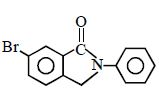
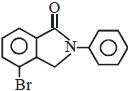
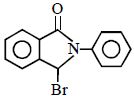
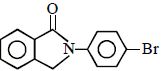
In the reaction the major product formed is
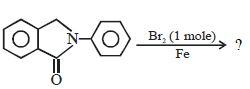
  • A

  • B

  • C


Answer

Correct option: D.

d
More activating gp

Need a full question paper?

Generate a complete, print-ready paper with questions like this in minutes — across 16+ boards, with answer keys.
Start Generating Free

Similar questions

$A + 2B + 3C \rightleftharpoons A{B_2}{C_3}$ Reaction of $6.0\, g$ of $A$, $6.0\times10^{23}$ atoms of $B$, and $0.036\, mol$ of $C$ yields $4.8\, g$ of compound $AB_2C_3$ . If the atomic mass of $A$ and $C$ are $60$ and $80\, amu$, respectively, the atomic mass of $B$ is .............. $\mathrm{amu}$ (Avogadro no . $= 6 \times10^{23}$)
In the presence of a small amount of phosphorous, aliphatic carboxylic acids react with chlorine or bromine to yield a compound in which $\alpha -$ hydrogen has been replaced by halogen. This reaction is known as
$K_{sp}$ for $BaSO_4$ at $25\,^oC$ is $1.1 \times 10^{-10}$ . To make the new solubility equal to $1.1 \times 10^{-8}$ , it is necessary to use the solution of $Na_2SO_4$ of the following concentration .......$M$
When zinc reacts with very dilute $HNO_3$, the oxidation state of nitrogen changes from
Out of molar entropy $(I)$, specific volume $(II)$, heat capacity $(III),$ volume $(IV)$ extensive properties are
At a given temperature, the equilibrium constant for reaction $PC{l_5}_{(g)}$ $\rightleftharpoons$ $PC{l_3}_{(g)} + C{l_2}_{(g)}$ is $2.4 \times {10^{ - 3}}$. At the same temperature, the equilibrium constant for reaction $PC{l_3}_{(g)} + C{l_2}_{(g)}$ $\rightleftharpoons$ $PC{l_5}_{(g)}$ is
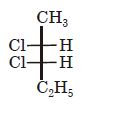
The absolute configuration of the compound is
A diatomic molecule has a dipole moment of $1.2 D$. If the bond distance is $1 \mathring A$, then fractional charge on each atom is.........$\times 10^{-1}$ esu.(Given $1 \mathrm{D}=10^{-18}$ esu $\mathrm{cm}$ )
Select equations having endothermic step

$(A)\,S_{\left( g \right)}^ - \,\, \to \,\,S_{\left( g \right)}^{2 - }\,$

$(B)\,Na_{\left( g \right)}^ + \, + \,Cl_{\left( g \right)}^ - \,\, \to \,\,NaCl\,(s)$

$(C)\,{N_{\left( g \right)}}\, \to \,\,N_{\left( g \right)}^ - $

$(D)\,Al_{\left( g \right)}^{2 + }\, \to \,\,Al_{\left( g \right)}^{3 + }$
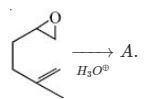
$‘A’$ is