MCQ
In the series combination of two or more than two resistances:
  • The current through each resistance is same.
  • B
    The voltage through each resistance is same.
  • C
    Neither current nor voltage through each resistance is same.
  • D
    Both current and voltage through each resistance are same.
Answer

Correct option: A.
The current through each resistance is same.

Need a full question paper?

Generate a complete, print-ready paper with questions like this in minutes — across 16+ boards, with answer keys.

Start Generating Free

Similar questions

Assertion : A disc-shaped magnet is deviated above a superconducting material that has been cooled by liquid nitrogen.

Reason : Superconductors repel a magnet.

During negative b - decay
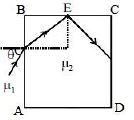
A transparent cube of side $d$, made of a material of refractive index $\mu_2$, is immersed in a liquid of refractive index $\mu_1(\mu_1 < \mu_2)$. A ray is incident on the face $AB$ at an angle $\theta $ (shown in the figure). Total internal reflection takes place at point $E$ on the face $BC$. The $\theta$ must satisfy
Light travels through a glass plate of thickness t and having refractive index n. If c is the velocity of light in vacuum, the time taken by the light to travel this thickness of glass is
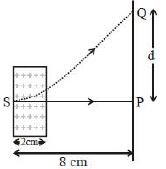
An electron, moving along the $x-$ axis with an initial energy of $100\, eV$, enters a region of magnetic field $\vec B = (1.5\times10^{-3}T)\hat k$ at $S$ (See figure). The field extends between $x = 0$ and $x = 2\, cm$. The electron is detected at the point $Q$ on a screen placed $8\, cm$ away from the point $S$. The distance $d$ between $P$ and $Q$ (on the screen) is :......$cm$ (electron's charge $= 1.6\times10^{-19}\, C$, mass of electron $= 9.1\times10^{-31}\, kg$)
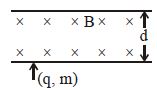
As shown in the figure, the uniform magnetic field between the two identical plates is $B$. There is a hole in plate. If through this hole a particle of charge $q$, mass $m$ and energy $E$ enters this magnetic field, then the particle will not collide  with the upper plate provided
When cells are connected in parallel, then
Assertion $(A):$ A particle of mass $M$ at rest decay into two particles of masses $m _1$ and $m _2$, having non-zero velocities will have ratio of de-Broglie wavelengths unity.

Reason $(R):$ Here we cannot apply conservation of linear momentum.

In a Young's double slit experiment, the central point on the screen is
If half-life of a radioactive atom is $2.3\, days$, then its decay constant would be