MCQ
In the standard equation $S_n=\text{u}+\frac{\text{a}}{2}[2\text{n}-1],$ what dimensions do you view for $S_n?$
  • A
    $\ce{M^{\circ} L^1 T^{\circ}}$
  • B
    $\ce{M^{\circ} L^{-1} T^1}$
  • $\ce{M^{\circ} L^1 T^{-1}}$
  • D
    $\ce{M^{\circ} L^{\circ} T^1}$

Answer

Correct option: C.
$\ce{M^{\circ} L^1 T^{-1}}$

Need a full question paper?

Generate a complete, print-ready paper with questions like this in minutes — across 16+ boards, with answer keys.
Start Generating Free

Similar questions

A lift is descending with acceleration $g/3$ . What will be the time period of a simple pendulum suspended from its ceiling if its time period in staionary life is $'T'$ ?
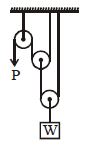
The ideal mechanical advantage of the combination of pulleys shown is
What is the number of significant figures in $11.118 \times 10^{ - 6}\,V$ 
A certain planet completes one rotation about its axis in time $T$. The weight of an object placed at the equator on the planet's surface is a fraction $f(f$ is close to unity) of its weight recorded at a latitude of $60^{\circ}$. The density of the planet (assumed to be a uniform perfect sphere) is given by
A pulley of rad ius $2\ m$ is rotated about its axis by a force $ F = (20t -5t^2)$  newton (where tis measured in seconds) applied tangentially. If the moment ofinertia of the pulley about its axis ofrotation is $10\ kg-m^2$ the number ofrotations made by the pulley before its d irection of motion is reversed , is
A clock which keeps correct time at ${20^o}C$, is subjected to ${40^o}C$. If coefficient of linear expansion of the pendulum is $12 \times {10^{ - 6}}/^\circ C$. How much will it gain or loose in time
The ratio of the $K.E.$ required to be given to the satellite to escape earth's gravitational field to the $K.E.$ required to be given so that the satellite moves in a circular orbit just above earth atmosphere is
Which of the following quantities are always negative in a $SHM$
A cylinder of radius $R$ is surrounded by a cylindrical shell of inner radius $R$ and outer radius $2R$. The thermal conductivity of the material of the inner cylinder is $K_1$ and that of the outer cylinder is $K_2$. Assuming no loss of heat, the effective thermal conductivity of the system for heat flowing along the length of the cylinder is
Find the gravitational field at a distance of $2000\, km$ from centre of earth. (in $m / s ^{2}$)

(Given $\left.R_{\text {earth }}=6400 km , r =2000 km , M _{\text {earth }}=6 \times 10^{24} kg \right)$