MCQ
In the wave equation $y =0.5 \sin \frac{2 \pi}{\lambda}(400 t - x )\,m$  the velocity of the wave will be ......... $m / s$
  • A
    $200$
  • B
    $200 \sqrt{2}$
  • $400$
  • D
    $400 \sqrt{2}$

Answer

Correct option: C.
$400$
c
$y =0.5 \sin \left(\frac{2 \pi}{\lambda} 400 t -\frac{2 \pi}{\lambda} x \right)$

$\omega=\frac{2 \pi}{\lambda} 400$

$K =\frac{2 \pi}{\lambda}$

$v =\frac{\omega}{ k } \quad[ v =400\,m / s ]$

Need a full question paper?

Generate a complete, print-ready paper with questions like this in minutes — across 16+ boards, with answer keys.

Start Generating Free

Similar questions

If the time of acceleration is $t_1$​, then the speed of the car at $t = t_1$​ is:
A Carnot's engine working between $400\, K$ and $800\, K$ has a work output of $1200\, J$ per cycle. The amount of heat energy supplied to the engine from the source in each cycle is ........... $J$
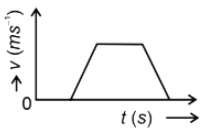
The velocity $(v)-$ time $(t)$ plot of the motion of a body is shown below:

(image)

The acceleration $(a)-$ time $(t)$ graph that best suits this motion is :
The equation of motion of a projectile is:   $y = 12x - \frac{5}{9}{x^2}$. The horizontal component of velocity is $3\ ms^{- 1}$ . Given that $g = 10\ ms^{- 2}$ , .......... $m$ is the range of the projectile .
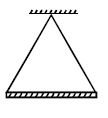
A rod of mass $m$ and length $l$ is suspended from ceiling with two string of length $l$ as shown. When the rod is given a small push in the plane of page and released time period is $T_1$ and when the rod is given a push perpendicular to plane time period of oscillation is $T_2$ . The ratio $\frac{{T_1^2}}{{T_2^2}}$ is
A particle moves for $20 \,seconds$ with velocity $3 \,m/s$ and then velocity $4\, m/s$ for another $20 \,seconds$ and finally moves with velocity $5 \,m/s$ for next $20\, seconds$. What is the average velocity of the particle..........$m/s$
Consider a point $P$ on the circumference of a disc rolling along a horizontal surface. If $R$ is the radius of the disc, the distance through which $P$ moves in one full rotation of the disc is
An ideal gas of Molar mass $M$ is contained in a vertical tube of height $H$, closed at both ends. The tube is accelerating vertically upwards with acceleration $g$ Then, the ratio of pressure at the bottom and the mid point of the tube will be
Mark the correct statements:
The gravitational field due to a mass distribution is $E = K/{x^3}$ in the $X-$direction. ($K$ is a constant). Taking the gravitational potential to be zero at infinity, its value at a distance $X$ is