Question

In the Young's double slit experiment, if the phase difference between the two waves interfering at a point is , the intensity at that point can be expressed by the expression (Where A and B depend upon the amplitudes of the two waves)

(a) I =  

(b) I =  

(c) I = A + Bcos  

(d) I = A + B Cos

Answer

(d) I = A + B Cos

Need a full question paper?

Generate a complete, print-ready paper with questions like this in minutes — across 16+ boards, with answer keys.

Start Generating Free

Similar questions

No current flows between two charged bodies connected together when they have the same

(a) Capacitance or   ratio

(b) Charge

 (c) Resistance

(d) Potential or  ratio

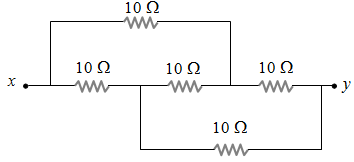
The equivalent resistance between x and y in the circuit shown is

(a) 10 W

(b) 40 W

(c) 20 W

(d)  

All of the following statements are true except

(a) Conductance is the reciprocal of resistance and is measured in Siemens

(b) Ohm's law is not applicable at very low and very high temperatures

(c) Ohm's law is applicable to semiconductors

(d) Ohm's law is not applicable to electron tubes, discharge tubes and electrolytes

The magnetic compass is not useful for navigation near the magnetic poles, since:

The force between the plates of a parallel plate capacitor of capacitance C and distance of separation of the plates d  with a potential difference V between the plates, is

(a)  

(b)

(c)    

(d)

Function of rectifier is

(a) To convert ac into dc

(b) To convert dc into ac

(c) Both (a) and (b)

(d) None of these

A conductor with a positive charge

(a) Is always at +ve  potential

(b) Is always at zero potential

(c) Is always at negative potential

(d) May be at +ve, zero or -ve potential

An electron (charge q coulomb) enters a magnetic field of H   with a velocity of vm/s  in the same direction as that of the field the force on the electron is

(a) Hqv Newton’s in the direction of the magnetic field 

(b) Hqv dynes in the direction of the magnetic field

(c) Hqv Newton’s at right angles to the direction of the magnetic field

(d) Zero

The constant k in Coulomb's law depends upon:

The intensity of electric field at a point between the plates of a charged capacitor

(a) Is directly proportional to the distance between the plates

(b) Is inversely proportional to the distance between the plates

(c) Is inversely proportional to the square of the distance between the plates

(d) Does not depend upon the distance between the plates