Question
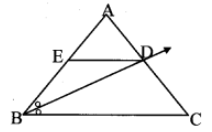
In $\triangle A B C$, ray $B D$ bisects $\angle A B C . A-D-C$, side $D E \|$ side $B C, A-E-B$, then prove that $\frac{A B}{B C}=\frac{A E}{E B}$
Image
In $\triangle A B C$, ray $B D$ bisects $\angle B$.
$\therefore \quad \frac{ AB }{ BC }=\frac{ AD }{ DC }$
In $\triangle ABC , DE \| BC$
$\therefore \quad \frac{ AE }{ EB }=\frac{ AD }{ DC }$
$\therefore \frac{ AB }{ ⬜ }=\frac{ ⬜ }{ EB }$
[Given]
[Angle biscetor theorem]
[Given]

[From (i) and (ii)]

Answer

In $\triangle A B C$, ray $B D$ bisects $\angle A B C . A-D-C$, side $D E \|$ side $B C, A-E-B$, then prove that $\frac{A B}{B C}=\frac{A E}{E B}$
Image
In $\triangle A B C$, ray $B D$ bisects $\angle B$.
$\therefore \quad \frac{ AB }{ BC }=\frac{ AD }{ DC }$
In $\triangle ABC , DE \| BC$
$\therefore \quad \frac{ AE }{ EB }=\frac{ AD }{ DC }$
$\therefore \frac{ AB }{ BC }=\frac{ AE }{ EB }$
[Given]
[Angle biscetor theorem]
[Given]
[Basic proportionality theorem]
[From (i) and (ii)]

Need a full question paper?

Generate a complete, print-ready paper with questions like this in minutes — across 16+ boards, with answer keys.

Start Generating Free

Similar questions

If ΔABC ~ ΔPQR, A (ΔABC) = 80, A(ΔPQR) = 125, then fill in the blanks.
$\frac{ A (\triangle ABC )}{ A (\Delta \ldots)}=\frac{80}{125}$
$\therefore \frac{ AB }{ PQ }$ = $[-]$
Find distance between point $A(-1,1)$ and point $B(5,-7)$ :
Solution: Suppose $A\left(x_1, y_1\right)$ and $B\left(x_2, y_2\right)$
$x_1=-1, y_1=1 \text { and } x_2=5, y_2=-7$
Using distance formula,
$ d(A, B)=\sqrt{\left(x_2-x_1\right)^2+\left(y_2-y_1\right)^2}$
$\therefore d(A, B)=\sqrt{\square+[(-7)+\square]^2}$
$\therefore d(A, B)=\sqrt{\square}$
$\therefore d(A, B)=\square $
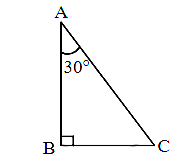
From given figure, In ∆ABC, If ∠ABC = 90° ∠CAB=30°, AC = 14 then for finding value of AB and BC, complete the following activity.

Activity: In $\triangle ABC$, If $\angle ABC =90^{\circ}, \angle CAB =30^{\circ}$
$
\therefore \angle B C A=\square
$
By theorem of $30^{\circ}-60^{\circ}-90^{\circ}$ triangle,
$\therefore \square=\frac{1}{2} AC$ and $\square=\frac{\sqrt{3}}{2} AC$
$\therefore BC =\frac{1}{2} \times \square$ and $AB =\frac{\sqrt{3}}{2} \times 14$
$\therefore BC =7$ and $AB =7 \sqrt{3}$
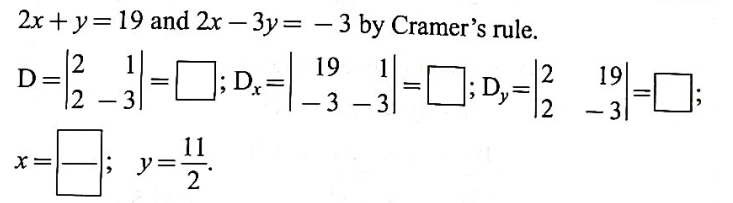
Complete the following activity to solve the simultaneous equations
Image
Write the values of the following trigonometric ratios.
$\cos 45^{\circ}=\frac{⬜}{⬜}$
If $\sec \theta+\tan \theta=\sqrt{3}$, complete the activity to find the value of $\sec \theta-\tan \theta$
Activity:
$ \square=1+\tan ^2 \theta \quad \ldots . . .[\text { Fundamental trigonometric identity] }$
$\square-\tan ^2 \theta=1$
$(\sec \theta+\tan \theta) \cdot(\sec \theta-\tan \theta)=\square$
$\sqrt{3} \cdot(\sec \theta-\tan \theta)=1$
$(\sec \theta-\tan \theta)=\square $
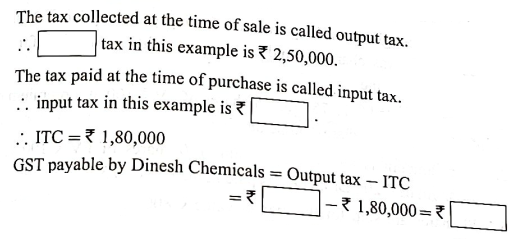
Dinesh Chemicals paid ₹ 1,80,000 GST for purchase of some chemicals and collected ₹ 2,50,000 GST at the time of sale. Complete the following activity to find the amount of GST payable by Dinesh Chemicals:

Image
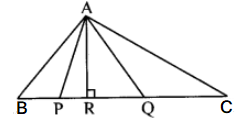
Find $\frac{A(\triangle A B C)}{A(\triangle A P Q)}$
Image
Solution :
In ∆ABC, BC is the base and AR is the height.
In ∆APQ, PQ is the base and AR is the height.
[The ratio of areas of two triangles is equal to the ratio of the product of their bases and corresponding heights]
$\therefore \frac{ A (\triangle ABC )}{ A (\triangle APQ )}=\frac{ ⬜ \times ⬜ }{ ⬜ \times ⬜ }$
$\therefore \frac{ A (\triangle ABC )}{ A (\triangle APQ )}=\frac{ ⬜ }{⬜}$
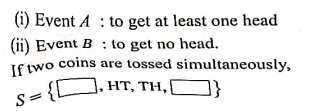
Two coins are tossed simultaneously. Complete the following activity of writing the sample space $(S)$ and expected outcomes of the events :
Image
Image
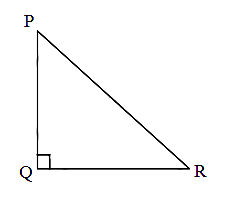
A ladder $10\ m$ long reaches a window $8\ m$ above the ground. Find the distance of the foot of the ladder from the base of wall. Complete the given activity.
Activity: As shown in figure suppose

PR is the length of ladder $=10 m$
At P - window, At Q - base of wall, At R - foot of ladder
$\therefore PQ =8 m$
$\therefore Q R=?$
In $\triangle P Q R, m \angle P Q R=90^{\circ}$
By Pythagoras Theorem,
$\therefore PQ ^2+\square= PR ^2$
Here, $P R=10, P Q=\square$
From equation (l)
$ 8^2+Q^2=10^2$
$Q R^2=10^2-8^2$
$Q R^2=100-64$
$Q R^2=\square$
$Q R=6 $
$\therefore$ The distance of foot of the ladder from the base of wall is $6 m$.