Question
In $\triangle ABC ; D$ and $E$ are mid$-$points of the sides $AB$ and $AC$ respectively. Through $E$, a straight line is drawn parallel to $AB$ to meet $BC$ at $F.$Prove that $\text{BDEF}$ is a parallelogram. If $AB = 16 \ cm, AC = 12 \ cm$ and $BC = 18 \ cm$,find the perimeter of the parallelogram $\text{BDEF}.$
Answer

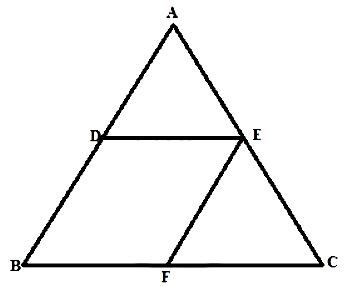
The figure is shown below

From figure since $E$ is the midpoint of $A C$ and $E F \| A B$
Therefore $F$ is the midpoint of $BC$ and $2 DE = BC$ or $DE = BF$
Again $D$ and $E$ are midpoints,
therefore $DE \| BF$ and $EF = BD$
Hence $\text{BDEF}$ is a parallelogram.
Now,
$BD = EF =\frac{1}{2} AB =\frac{1}{2} \times 16=8 \ cm$
$ BF = DE =\frac{1}{2} BC =\frac{1}{2} \times 18=9 \ cm$
Therefore perimeter of $BDEF =2(B F+E F)=2(9+8)=34 \ cm$.

Need a full question paper?

Generate a complete, print-ready paper with questions like this in minutes — across 16+ boards, with answer keys.

Start Generating Free

Similar questions

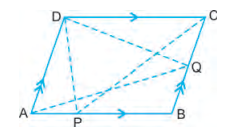
In the adjoining figure, ABCD is a parallelogram. P and Q are any two points on the sides AB and BC respectively. Prove that : ar $(\triangle CPD )=\operatorname{ar}(\triangle AQD )$.
Image
Prove that the points $A (1, -3), B (-3, 0)$ and $C (4, 1)$ are the vertices of an isosceles right$-$angled triangle. Find the area of the triangle.
$A (- 2, 2), B(8, 2)$ and $C(4, - 4)$ are the vertices of a parallelogram $\text{ABCD}$. By plotting the given points on a graph paper; find the co$-$ordinates of the fourth vertex $D$.Also, form the sazmegraph,state the co$-$ordinates of the mid$-$points of the sides $AB$ and $CD.$
Find the length of $22\ kg$ copper wire of diameter $0.8\ cm,$ if the weight of $1 \ cm^3$ copper is $4.2\ g.$
Find the number of bricks, each measuring $25 cm \quad 12.5 cm \quad 7.5 cm$, required to construct a wall 6 m long, 5 m high and 50 cm thick, while the cement and the sand mixture occupies $\frac{1}{20}$ th of the volume of the wall.
Find the circumference and area of a circle of radius 17.5 cm.
A rectangular courtyard 3.78 m long and 5.25 m broad is to be paved exactly with square tiles, all of the same size. What is the largest size of such a tile? Also, find the number of tiles.
Draw the graph for the linear equation given below:$2x - 7 = 0$
The mean of $6$ numbers is $42.$ If one number is excluded$,$ the mean of the remaining number is $45.$ Find the excluded number.
Find the area of a right angled triangle whose hypotenuse is $15\ cm$ and the base is $9\ cm.$