MCQ
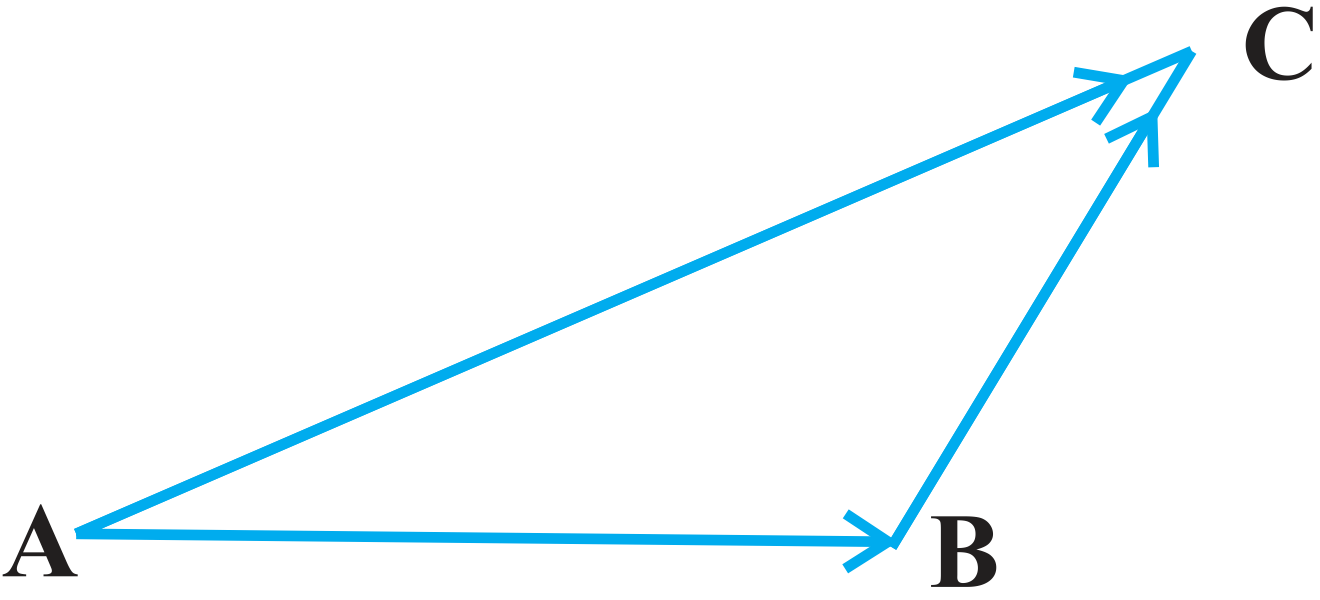
In triangle ABC (Fig 10.18), which of the following is not true:
  • A
    $\overrightarrow{\text{AB}}+\overrightarrow{\text{BC}}+\overrightarrow{\text{CA}}=\vec{0}$
  • B
    $\overrightarrow{\text{AB}}+\overrightarrow{\text{BC}}-\overrightarrow{\text{AC}}=\vec{0}$
  • $\overrightarrow{\text{AB}}+\overrightarrow{\text{BC}}-\overrightarrow{\text{CA}}=\vec{0}$
  • D
    $\overrightarrow{\text{AB}}-\overrightarrow{\text{CB}}+\overrightarrow{\text{CA}}=\vec{0}$
Answer

Correct option: C.
$\overrightarrow{\text{AB}}+\overrightarrow{\text{BC}}-\overrightarrow{\text{CA}}=\vec{0}$

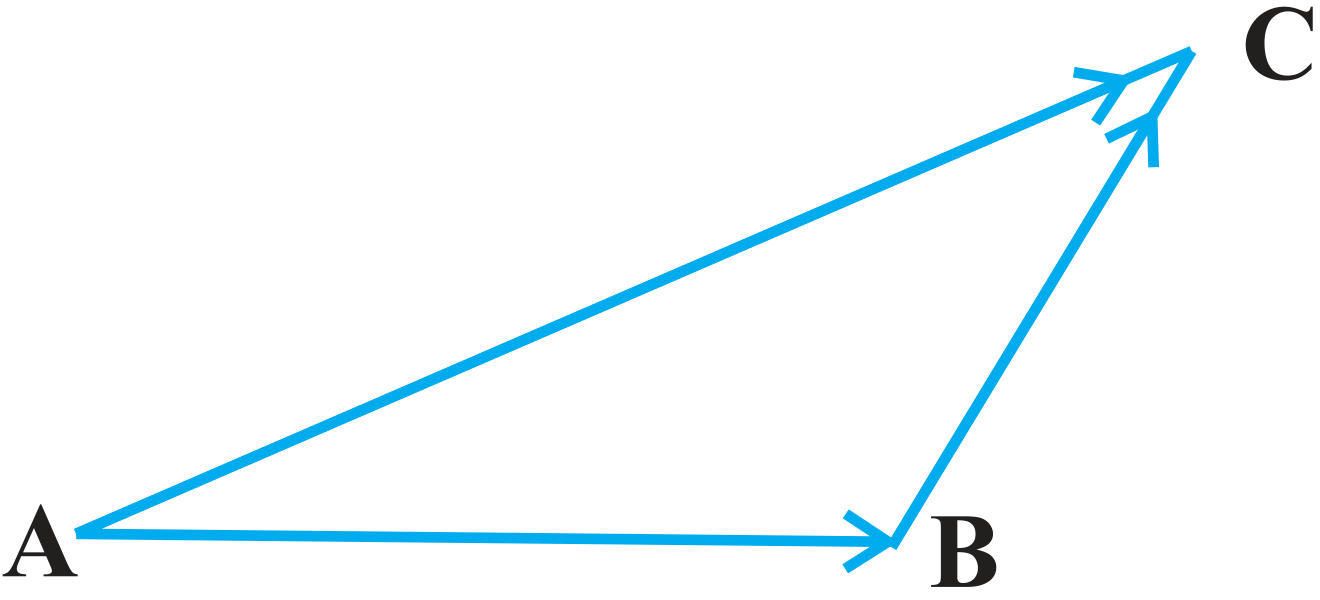
On applying the triangle law of addition in the given triangle, we have:
$\overrightarrow{\text{AB}}+\overrightarrow{\text{BC}}=\overrightarrow{\text{AC}}\ \ \ \ \ \ \ \ \ ....(1)$
$\Rightarrow\overrightarrow{\text{AB}}+\overrightarrow{\text{BC}}=-\overrightarrow{\text{CA}}$
$\Rightarrow\overrightarrow{\text{AB}}+\overrightarrow{\text{BC}}+\overrightarrow{\text{CA}}=\vec{0}\ \ \ \ ....(2)$
$\therefore$ The equation given in alternative A is true.
$\overrightarrow{\text{AB}}+\overrightarrow{\text{BC}}=\overrightarrow{\text{AC}}$
$\Rightarrow\overrightarrow{\text{AB}}+\overrightarrow{\text{BC}}-\overrightarrow{\text{AC}}=\vec{0}$
$\therefore$ The equation given in alternative B is true.
From equation (2), we have:
$\overrightarrow{\text{AB}}-\overrightarrow{\text{CB}}+\overrightarrow{\text{CA}}=\vec{0}$
$\therefore$ The equation given in alternative D is true.
Now, consider the equation given in alternative C:
$\overrightarrow{\text{AB}}+\overrightarrow{\text{BC}}-\overrightarrow{\text{CA}}=\vec{0}$
$\Rightarrow\overrightarrow{\text{AB}}+\overrightarrow{\text{BC}}=\overrightarrow{\text{CA}}\ \ \ \ ....(3)$
From equations (1) and (3), we have:
$\overrightarrow{\text{AC}}=\overrightarrow{\text{CA}}$
$\Rightarrow\overrightarrow{\text{AC}}=-\overrightarrow{\text{AC}}$
$\Rightarrow\overrightarrow{\text{AC}}+\overrightarrow{\text{AC}}=\vec{0}$
$\Rightarrow2\overrightarrow{\text{AC}}=\vec{0}$
$\Rightarrow\overrightarrow{\text{AC}}=\vec{0},$ which is not true.
Hence, the equation given in alternative C is incorrect.
The correct answer is C.

Need a full question paper?

Generate a complete, print-ready paper with questions like this in minutes — across 16+ boards, with answer keys.

Start Generating Free

Similar questions

The number of functions $f$, from the set$A=\left\{x \in N: x^{2}-10 x+9 \leq 0\right\}$ to the set $B=\left\{n^{2}: n \in N\right\}$ such that $f(x) \leq(x-3)^{2}+1$, for every $x \in A$, is.
The order and degree of the differential equation $\left(y^{\prime \prime \prime}\right)^2+\left(y^{\prime \prime}\right)^3-\left(y^{\prime}\right)^4+y^5=0$ is :
For which value of $x$, are the determinants $\left|\begin{array}{ll}2 x & -3 \\ 5 & x\end{array}\right|$ and $\left|\begin{array}{cc}10 & 1 \\ -3 & 2\end{array}\right|$ equal?
$f(x) = {x^3} - 27x + 5$ is an increasing function, when
Let $\vec{a}$ and $\vec{b}$ be two vectors such that $|\vec{b}|=1$ and $|\vec{b} \times \vec{a}|=2$. Then $|(\vec{b} \times \vec{a})-\vec{b}|^2$ is equal to
Let $g(x) = x.\,f(x),$ where $f(x) = \left\{ \begin{array}{l}x\sin \frac{1}{x},\,x \ne 0\\\,\,\,\,\,\,\,\,\,\,\,\,0,\,x = 0\end{array} \right.$ at $x = 0$
Let $A =\{2,3,4,5, \ldots ., 30\}$ and $^{\prime} \simeq ^{\prime}$ be an equivalence relation on $A \times A ,$ defined by $(a, b) \simeq (c, d),$ if and only if $a d=b c .$ Then the number of ordered pairs which satisfy this equivalence relation with ordered pair $(4,3)$ is equal to :
If the general solution of the differential equation $y' = \frac{y}{x} + \phi \left( {\frac{x}{y}} \right)$ , for some function $\phi $, is given by $y \ln \,\left| {cx} \right| = x$, where $c$ is an arbitrary constant, then $\phi \,(2)$ is equal to:
The smallest and the largest values of ${\tan ^{ - 1}}\left( {\frac{{1 - x}}{{1 + x}}} \right){\rm{ }},\,\,0 \le x \le 1$ are
The order and the degree of differential equation $\frac{{{d^4}y}}{{d{x^4}}} - 4\frac{{{d^3}y}}{{d{x^3}}} + 8\frac{{{d^2}y}}{{d{x^2}}} - 8\frac{{dy}}{{dx}} + 4y = 0$ are respectively