Question
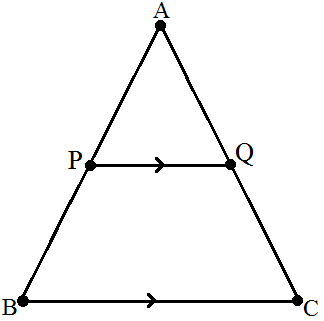
In $\triangle\text{ABC, PQ}$ is a line segment intersecting AB at P and AC at Q such that PQ || BC and PQ divides $\triangle\text{ABC}$ into two parts equal in area. Find $\frac{\text{BP}}{\text{AB}}.$
Answer


We have,
PQ || BC
And ar $(\triangle\text{APQ})$ = ar(trap. PQCB)
$\Rightarrow\text{ar}(\triangle\text{APQ})=\text{ar}(\triangle\text{ABC})-\text{ar}(\triangle\text{APQ})$
$\Rightarrow\text{2ar}(\triangle\text{APQ})=\text{ar}(\triangle\text{ABC})\ \ ...(\text{i})$
In $\triangle\text{APQ and }\triangle\text{ABC}$
$\angle\text{A}=\angle\text{A}$ [Common]
$\angle\text{APQ}=\angle\text{B}$ [Corresponding angles]
Then, $\triangle\text{APQ}\sim\triangle\text{ABC}$ [By AA similarity]
$\therefore$ By area of similar triangle theorem
$\frac{\text{ar}(\triangle\text{APQ})}{\text{ar}(\triangle\text{ABC})}=\frac{\text{AP}^2}{\text{AB}^2}$
$\Rightarrow\frac{\text{ar}(\triangle\text{APQ})}{\text{ar}(\triangle\text{APQ})}=\frac{\text{AP}^2}{\text{AB}^2}\ \ [\text{By using (i)}]$
$\Rightarrow\frac{1}{2}=\frac{\text{AP}^2}{\text{AB}^2}$
$\Rightarrow\frac{1}{\sqrt{2}}=\frac{\text{AP}}{\text{AB}^2}$
$\Rightarrow\frac{1}{\sqrt{2}}=\frac{\text{AP}}{\text{AB}}$ [Taking square root]
$\Rightarrow\frac{1}{\sqrt{2}}=\frac{\text{AB}-\text{BP}}{\text{AB}}$
$\Rightarrow\frac{1}{\sqrt{2}}=\frac{\text{AB}}{\text{AB}}-\frac{\text{BP}}{\text{AB}}$
$\Rightarrow\frac{1}{\sqrt{2}}=1-\frac{\text{BP}}{\text{AB}}$
$\Rightarrow\frac{\text{BP}}{\text{AB}}=1-\frac{1}{\sqrt{2}}$
$\Rightarrow\frac{\text{BP}}{\text{AB}}=\frac{\sqrt{2}-1}{\sqrt{2}}$

Need a full question paper?

Generate a complete, print-ready paper with questions like this in minutes — across 16+ boards, with answer keys.
Start Generating Free

Similar questions

Find the ratio in which the line segment joining the points $(6,4)$ and $(1,-7)$ is divided by X -axis.
Solve the following equations by Cramer’s method.
4m – 2n = –4; 4m + 3n = 16
A rectangular courtyard is $18\ m 72\ cm$ long and $13\ m 20\ cm$ broad. it is to be paved with square tiles of the same size.
Find the least possible number of such tiles.
An iron pole consisting of a cylindrical portion $110\ cm$ high and of base diameter $12\ cm$ is surmounted by a cone $9\ cm$ high. Find the mass of the pole, given that $1\ cm^3$​​​​​​​ of iron has $8$ gram mass approximately. $\Big(\text{Use}:\ \pi=\frac{355}{115}\Big)$
Fill in the blanks with the help of given information for the table given below.
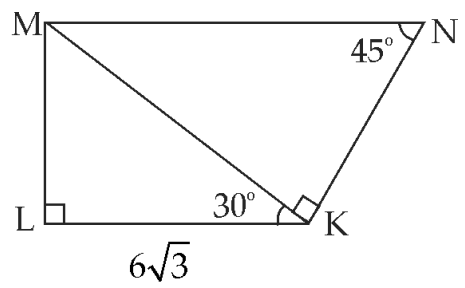
In the adjoining figure, $\angle$L = $\angle$MKN = 90°, $\angle$MKL = 30° and $\angle$MNK = 45°. If KL = $6 \sqrt{3}$, then find MK, ML, KN, MN and perimeter of $\square$MNKL.
Image
If radii of two circles are 4 cm and 2.8 cm. Draw figure of these circles touching each other –
(i) externally
(ii) internally.

Find the zeros of the following quadratic polynomial and verify the relationship between the zeros and the coefficients:
$x^2 + 3x - 10$
Write the sequence with $n^{th}$​​​​​​​ term:
$a_n = 5 + 2n.$
Show the all of the above sequences form A.P.
In which of the following situations, the sequence of numbers formed will form an A.P.?
The cost of digging a well for the first metre is Rs. 150 and rises by Rs. 20 for each succeeding metre.