Question
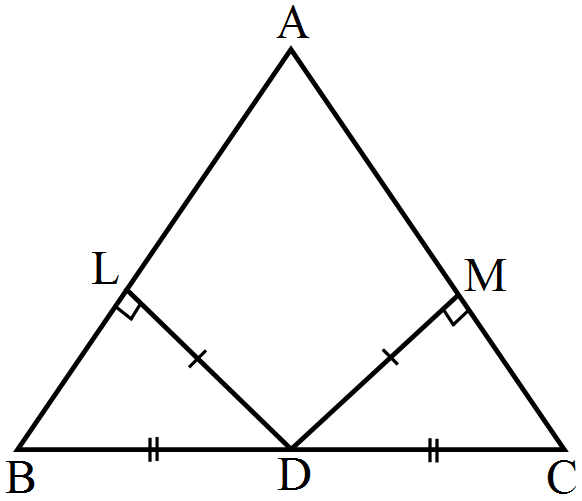
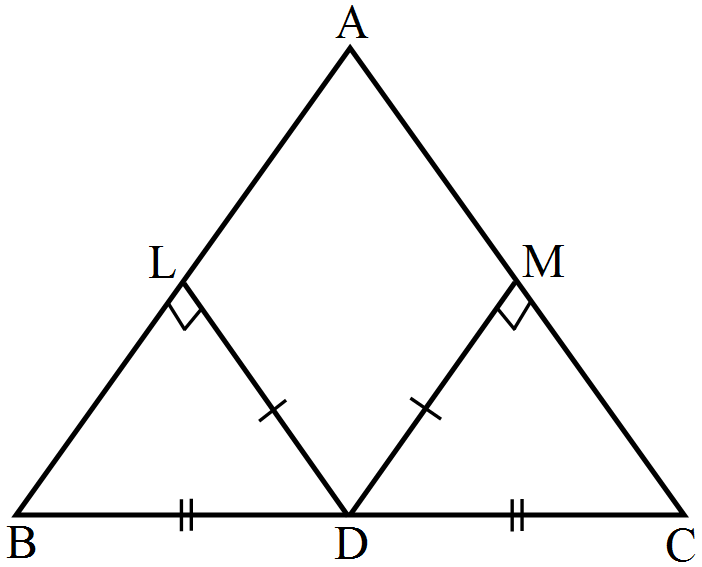
In $\triangle\text{ABC,D}$ is the midpoint of BC. If $\text{DL}\perp\text{AB}$ and $\text{DM}\perp\text{AC}$ such that DL = DM, prove that AB = AC.
Answer

Given: In a $\triangle\text{ABC,D}$ is the midpoint of BC and $\text{DL}\perp\text{AB}$ and $\text{DM}\perp\text{AC}.$ Also, DL = DM To prove: $\text{AB = AC}$ proof: In right angle triangles $\triangle\text{BLD}$ and $\triangle\text{CMD}$$\angle\text{BLD}=\angle\text{CMD}=90^{\circ}$
$\text{Hypt.BD = Hypt.CD}$ [Given]
$\text{DL = DM}$ [Given]
Thus, by Right Angle-Hypotenuse-Side criterion of congruence, we have$\triangle\text{BLD}=\triangle\text{CMD}$ [By RHS]
The corresponding parts of the congruent triangle are equal.$\therefore\angle\text{ABD}=\angle\text{ACD}$ [C.P.C.T.]
In $\triangle\text{ABC,}$we have$\angle\text{ABD}=\angle\text{ACD}$
$\Rightarrow\text{AB = AC}$
[$\therefore$ side oposite to equal angles are equal]

Need a full question paper?

Generate a complete, print-ready paper with questions like this in minutes — across 16+ boards, with answer keys.
Start Generating Free

Similar questions

Divide each of the following polynomials by synthetic division method and also by linear division method. Write the quotient and the remainder : $(x^4 – 3x^2 – 8) ÷ (x + 4)$
In ∆ABC, bisectors of ∠A and ∠B intersect at point O. If ∠C = 70°, find the measure of ∠AOB.
On a graph paper, plot the points (0, 1), (1, 3), (2, 5). Are they collinear? If so, draw the line that passes through them.
i. Through which quadrants does this line pass ?
ii. Write the co-ordinates of the point at which it intersects the Y-axis.
iii. Show any point in the third quadrant which lies on this line. Write the co-ordinates of the point.
The sum of the deviations of a set of n values $x_1, x_2, x_3,..., x_n$ measured from $15$ and $-3$ are $-90$ and $54$ respectively. Find the value of n and mean.
Construct ∆ABC such that ∠B =100°, BC = 6.4 cm, ∠C = 50° and construct its incircle.
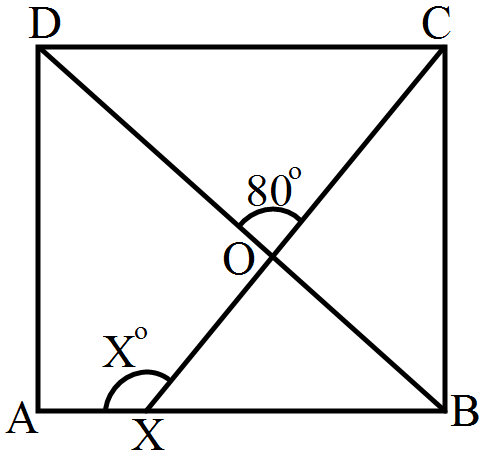
In the adjoining figure, ABCD is a square. A line segment CX cuts AB at X and the diagonal BD at O such that $\angle\text{COD}=80^{\circ}$ and $\angle\text{OXA}=\text{x}^{\circ}.$ Find the value of x.
If the co-ordinate of A is x and that of B is . y, find d(A, B).
i. x = 1, y = 7
ii. x = 6, y = -2
iii. x = -3, y = 7
iv. x = -4, y = -5
v. x = -3, y = -6
vi. x = 4, y = -8
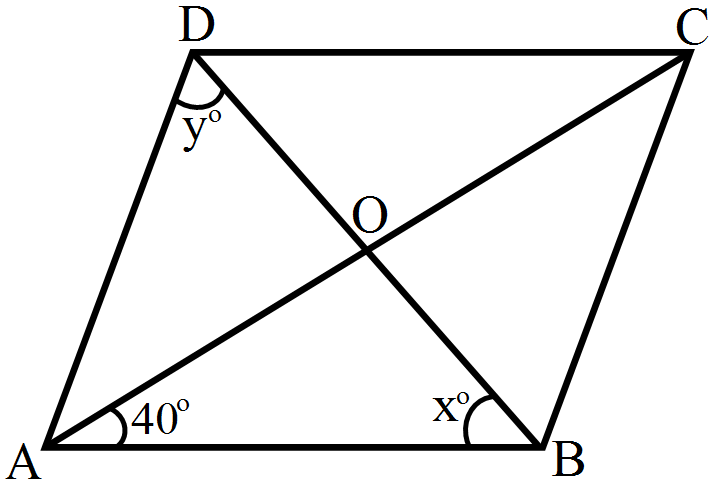
In each of the figures given below, ABCD is a rhombus. Find the value of x and y in each case.
Find the distances with the help of the number line given below.

Image
i. d(B, E)
ii. d (J, J)
iii. d(P, C)
iv. d(J, H)
v. d(K, O)
vi. d(O, E)
vii. d(P, J)
viii. d(Q, B)

Find the measure of each angle of a parallelogram, if one of its angles is 30° less than twice the smallest angle.
