Question
In tug of war, the team that exerts a larger tangential force on the ground wins. Consider the period in which a team is dragging the opposite team by applying a larger tangential force on the ground. List which of the following works are positive, which are negative and which are zero?
  1. Work by the winning team on the losing team.
  2. Work by the losing team on the winning team.
  3. Work by the ground on the winning team.
  4. Work by the ground on the losing team.
  5. Total external work on the two teams.

Answer

  1. Work by the winning team on the losing team is positive, as the displacement of the losing team is along the force applied by the winning team.
  2. Work by the losing team on the winning team is negative, as the displacement of the winning team is opposite to the force applied by losing team.
  3. Work by the ground on the winning team is positive.
  4. Work by the ground on the losing team is negative.
  5. Total external work on the two teams is positive.

Need a full question paper?

Generate a complete, print-ready paper with questions like this in minutes — across 16+ boards, with answer keys.

Start Generating Free

Similar questions

Why do marine animals live deep inside a lake when the surface of the lake freezes?
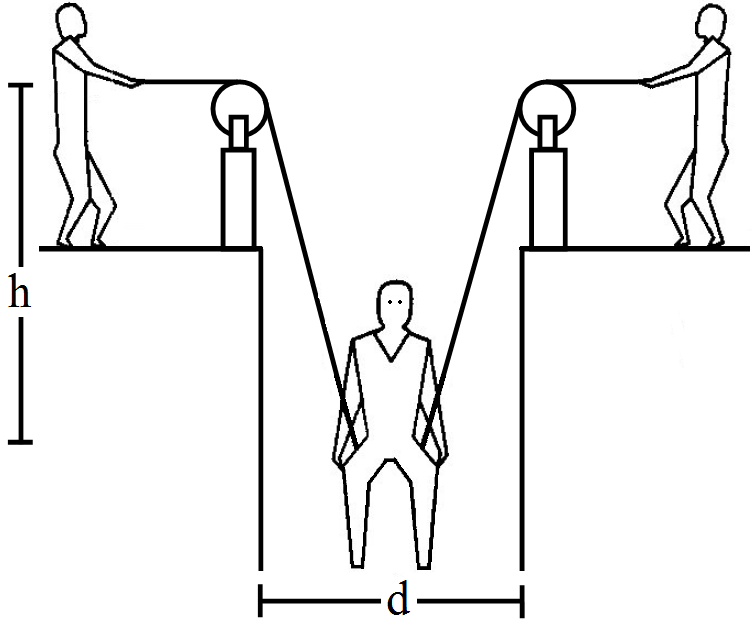
A man has fallen into a ditch of width d and two of his friends are slowly pulling him out using a light rope and two fixed pulleys as shown in figure. Show that the force (assumed equal for both the friends) exerted by each friend on the road increases as the man moves up. Find the force when the man is at a depth h.
Read the passage given below and answer the following questions from (i) to (v). Monatomic Gases: The molecule of a monatomic gas has only three translational degrees of freedom. Thus, the average energy of a molecule at temperature T is $\frac{3}{2}\text{K}_\text{b}\text{T}$. The total internal energy of a mole of such a gas is $\text{U}=(\frac{3}{2})\text{RT}$. The molar specific heat at constant volume cv is given by$\text{C}_{\text{v}}=\frac{\text{Du}}{\text{Dt}}=(\frac{3}{2})\text{R}$
For an ideal gas, $C_p - C_v = R$ Where Cp is the molar specific heat at constant pressure. Thus, $\text{C}_\text{P} =(\frac{5}{2})\text{R}$ The ratio of specific heats IS $\gamma=\frac{\text{cp}}{\text{cv}}=\frac{5}{3}$ Diatomic Gases: a diatomic molecule treated as a rigid rotator, like a dumbbell, has 5 degrees of freedom: 3 translational and 2 rotational. Using the law of equipartition of energy, the total internal energy of a mole of such a gas is $\text{U}=\frac{5}{2}\text{RT}$ The molar specific heat at constant volume cv is given by$\text{Cv}=\frac{\text{DU}}{\text{DT}}=(\frac{5}{2})\text{R}$
For an ideal gas, $C_p – C_v= R$ Where Cp is the molar specific heat at constant pressure. Thus, $\text{C}_\text{P} =(\frac{7}{2})\text{R}$ The ratio of specific heats IS $γ( \text{for rigid diatomic)}=\frac{\text{C}_\text{P}}{\text{C}_\text{v}} =(\frac{7}{5})\text{R}$ For non rigid diatomic molecules they have additional mode of vibrations therefore$\gamma=\frac{\text{C}_\text{p}}{\text{C}_\text{v}}=\frac{9}{7}$
Polyatomic Gases: In general a polyatomic molecule has 3 translational, 3 rotational degrees of freedom and a certain number (f) of vibrational modes. According to the law of equipartition of energy, it is easily seen that one mole of such a gas has$ C_v= (3 + f)$ R and $C_p= (4 + f) R$ and $\gamma=\frac{(4 + \text{f})}{(3+\text{f})}$
  1. For monatomic molecules ratio of specific heats is $\gamma$
  1. $\frac{5}{3}$
  2. $\frac{7}{5}$
  3. $\frac{9}{5}$
  4. None of these
  1. For diatomic rigid molecules ratio of specific heats is γ
  1. $\frac{5}{3}$
  2. $\frac{7}{5}$
  3. $\frac{9}{7}$
  4. None of these
  1. For diatomic non rigid molecules ratio of specific heats is γ
  1. $\frac{5}{3}$
  2. $\frac{7}{5}$
  3. $\frac{9}{7}$
  4. None of these
  1. Give cp and cv values and ratio of specific heat for monatomic gas molecules.
  2. Give cp and cv values and ratio of specific heat for polyatomic gas molecules
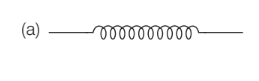
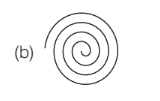
Read the passage given below and answer the following questions from 1 to 5. PE of Spring There are many types of spring. Important among these are helical and spiral springs as shown in figure.


Usually, we assume that the springs are massless. Therefore, work done is stored in the spring in the form of elastic potential energy of the spring. Thus, potential energy of a spring is the energy associated with the state of compression or expansion of an elastic spring.
  1. The potential energy of a body is increases in which of the following cases?
  1. If work is done by conservative force
  2. If work is done against conservative force
  3. If work is done by non-conservative force
  4. If work is done against non- conservative force
  1. The potential energy, i.e. U (x) can be assumed zero when:
  1. x = 0
  2. gravitational force is constant
  3. infinite distance from the gravitational source
  4. All of the above
  1. The ratio of spring constants of two springs is 2 : 3. What is the ratio of their potential energy, if they are stretched by the same force?
  1. 2 : 3
  2. 3 : 2
  3. 4 : 9
  4. 9 : 4
  1. The potential energy of a spring increases by 15 J when stretched by 3cm. If it is stretched by 4cm, the increase in potential energy is:
  1. 27 J
  2. 30 J
  3. 33 J
  4. 36 J
  1. The potential energy of a spring when stretched through a distance x is 10 J. What is the amount of work done on the same spring to stretch it through an additional distance x?
  1. 10 J
  2. 20 J
  3. 30 J
  4. 40 J
A sample contains a mixture of $^{108}Ag$ and $^{110}Ag$ isotopes each having an activity of $8.0 \times 10^8$ disintegration per second. $^{110}Ag$ is known to have larger half-life than $^{108}Ag$. The activity A is measured as a function of time and the following data are obtained.
Time (s) Activity (A) ($10^8$ disinte- grations $s^{-1}$) Time (s) Activity (A) ($10^8$ disinte-grations $s^{-1}$)
20 11.799 200 3.0828
40 9.1680 300 1.8899
60 7.4492 400 1.1671
80 6.2684 500 0.7212
100 5.4115    
  1. Plot ln $\Big(\frac{\text{A}}{\text{A}_0}\Big)$ versus time.
  2. See that for large values of time, the plot is nearly linear. Deduce the half-life of $^{110}Ag$ from this portion of the plot.
  3. Use the half-life of $^{110}Ag$ to calculate the activity corresponding to $^{108}Ag$ in the first $50s$.
  4. Plot In $\Big(\frac{\text{A}}{\text{A}_0}\Big)$ versus time for $^{108}Ag$ for the first $50s$.
  5. Find the half-life of $^{108}Ag$.
Read the passage given below and answer the following questions from 1 to 5. According to Hooke’s law, within the elastic limit, the stress applied to a body is directly proportional to the corresponding strain. $\text{Stress}\propto\text{Strain}$ or Stress = E × Strain or $\frac{\text{Stress }}{\text{Strain}}=\text{E}$ Where E is the constant of proportionality and is known as coefficient of elasticity or modulus of elasticity. Hooke’s law is an empirical law and is found to be valid for most materials. However, there are some materials which do not exhibit this linear relationship.
  1. According to Hooke’s law of elasticity, if stress is increased, the ratio of stress to strain:
  1. Decreases
  2. Increases
  3. Becomes zero
  4. Remains constant
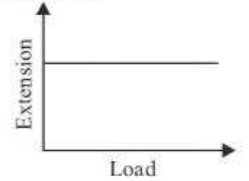
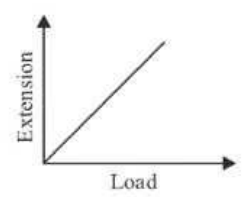
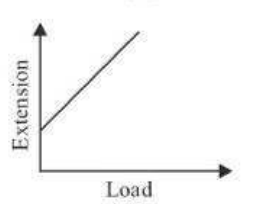
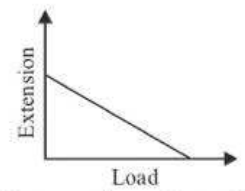
  1. Within elastic limit, which of the following graphs correctly represents the variation of extension in the length of a wire with the external load?
  1. According to Hooke’s law, ifstressis reduced to one-third, the ratio of stress to strain:
  1. Is increased to three time
  2. Is decreased
  3. Is zero
  4. Remains constant.
  1. Hooke’s law defines:
  1. Stress
  2. Strain
  3. Modulus of elasticity
  4. Elastic limit.
  1. Whenever a material is loaded with elasitic limits, stress is ......... strain.
  1. Equal to
  2. Directly proportional to
  3. Inxessely propotional to
  4. None of the above given remains constant.
Read the passage given below and answer the following questions from 1 to 5.
When we speak, the sound moves outward from us, without any flow of air from one part of the medium to another. The disturbances produced in air are much less obvious and only our ears or a microphone can detect them. These patterns, which move without the actual physical transfer or flow of matter as a whole, are called waves. The most familiar type of waves such as waves on a string, water waves, sound waves, seismic waves, etc. is the so-called mechanical waves. These waves require a medium for propagation, they cannot propagate through vacuum. They involve oscillations of constituent particles and depend on the elastic properties of the medium. The electromagnetic waves that you will learn in Class XII are a different type of wave. Electromagnetic waves do not necessarily require a medium – they can travel through vacuum. Light, radio waves, X-rays, are all electromagnetic waves. We have seen that motion of mechanical waves involves oscillations of constituents of the medium. If the constituents of the medium oscillate perpendicular to the direction of wave propagation, we call the wave a transverse wave. If they oscillate along the direction of wave propagation, we call the wave a longitudinal wave. In transverse waves, the particle motion is normal to the direction of propagation of the wave. Therefore, as the wave propagates, each element of the medium undergoes a shearing strain. Transverse waves can, therefore, be propagated only in those media, which can sustain shearing stress, such as solids and not in fluids. Fluids, as well as, solids can sustain compressive strain; therefore, longitudinal waves can be propagated in all elastic media.
For example, in medium like steel, both transverse and longitudinal waves can propagate, while air can sustain only longitudinal waves. Answer the following.
  1. Air can sustain:
  1. Transverse waves
  2. Longitudinal waves
  3. Both a and b
  4. None of these
  1. The electromagnetic waves can pass through
  1. Solids only
  2. Fluids only
  3. Any medium even through vacuum
  4. None of these
  1. Define Transverse waves
  1. Define longitudinal waves
  1. Differentiate between Transverse waves and longitudinal waves
Read the passage given below and answer the following questions from 1 to 5. In general, the errors in measurement can be broadly classified as (a) systematic errors and (b) random errors. Systematic errors: The systematic errors are those errors that tend to be in one direction, either positive or negative. Some of the sources of systematic errors are: (a) Instrumental errors that arise from the errors due to imperfect design or calibration of the measuring instrument, zero error in the instrument, etc. For example, the temperature graduations of a thermometer may be inadequately calibrated (it may read 104 °C at the boiling point of water at STP whereas it should read 100 °C); in a vernier calipers the zero mark of vernier scale may not coincide with the zero mark of the main scale, or simply an ordinary metre scale may be worn off at one end. (b) Imperfection in experimental technique or procedure to determine the temperature of a human body, a thermometer placed under the armpit will always give a temperature lowers than the actual value of the body temperature. (c) Personal errors that arise due to an individual’s bias, lack of proper setting of the apparatus or individual’s carelessness in taking observations without observing proper precautions, etc. For example, if you, by habit, always hold your head a bit too far to the right while reading the position of a needle on the scale, you will introduce an error due to parallax.Systematic errors can be minimized by improving experimental techniques, selecting better instruments and removing personal bias as far as possible. For a given set-up, these errors may be estimated to a certain extent and the necessary corrections may be applied to the readings. Random errors:The random errors are those errors, which occur irregularly and hence are random with respect to sign and size. These can arise due to random and unpredictable fluctuations in experimental conditions (e.g. unpredictable fluctuations in temperature, voltage), personal (unbiased) errors by the observer taking readings, etc. For example, when the same person repeats the same observation, it is very likely that he may get different readings every time. Least count error: The smallest value that can be measured by the measuring instrument is called its least count. All the readings or measured values are good only up to this value. The least count error is the error associated with the resolution of the instrument.
  1. The errors due to imperfect design or calibration of the measuring instrument:
  1. Instrumental error
  2. Random error
  3. Least count error
  4. None of the above
  1. The errors which occur irregularly
  1. Instrumental error
  2. Personal error
  3. Random error
  4. None of these
  1. Write a note on least count error
  1. Write a note on random error
  1. Write a note on systematic error
If the temperature of a tungsten filament is raised from 2000K to 2010K, by what factor does the emission current change? Work function of tungsten is 4.5eV.
Read the passage given below and answer the following questions from 1 to 5. The average velocity tells us how fast an object has been moving over a given time interval but does not tell us how fast it moves at different instants of time during that interval. For this, we define instantaneous velocity or simply velocity v at an instant t. The velocity at an instant is defined as the limit of the average velocity as the time interval Dt becomes infinitesimally small. In other words. $\text{V}=\lim_{\text{dt}-0}\frac{\text{dx}}{\text{dt}}$ $\text{v}=\frac{\text{dx}}{\text{dt}}$ The variation in velocity with time for an object moving in a straight line can be represented by a velocity-time graph. In this graph, time is represented along the x-axis and the velocity is represented along the y-axis. We know that the product of velocity and time give displacement of an object moving with uniform velocity. The area enclosed by velocity-time graph and the time axis will be equal to the magnitude of the displacement and slope of velocity time graph represents acceleration of object. The variation in distance with time for an object moving in a straight line can be represented by a position-time graph. In this graph, time is represented along the x-axis and the displacement is represented along the y-axis. Answer the following questions based on paragraph given.
  1. The area under velocity time graph gives:
  1. Displacement over given time interval
  2. Acceleration
  3. Velocity
  4. None of these
  1. Slope of velocity time graph gives
  1. Acceleration
  2. Velocity
  3. Distance
  4. Displacement.
  1. Write note on velocity time graph.
  1. Write a note on position time graph
  1. What is instantaneous velocity ?