MCQ
In uniform circular motion
  • A
    Both the angular velocity and the angular momentum vary
  • B
    The angular velocity varies but the angular momentum remains constant
  • Both the angular velocity and the angular momentum stay constant
  • D
    The angular momentum varies but the angular velocity remains constant
Answer

Correct option: C.
Both the angular velocity and the angular momentum stay constant
c
(c) $L = I\omega .$

In U.C.M. $\omega$ =constant  $L =$ constant.

Need a full question paper?

Generate a complete, print-ready paper with questions like this in minutes — across 16+ boards, with answer keys.

Start Generating Free

Similar questions

Paramagnetic substances:

$A$. align themselves along the directions of external magnetic field.

$B$. attract strongly towards external magnetic field.

$C$. has susceptibility little more than zero.

$D$. move from a region of strong magnetic field to weak magnetic field.

Choose the most appropriate answer from the options given below:

A small ball of mass $m$ and density $\rho$ is dropped in a viscous liquid of density $\rho_0$. After sometime, the ball falls with constant velocity. The viscous force on the ball is :
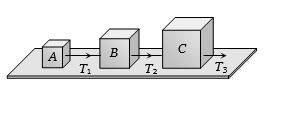
Three blocks $A, B$ and $C $ weighing $1, 8$ and $27\, kg$ respectively are connected as shown in the figure with an inextensible string and are moving on a smooth surface. ${T_3}$ is equal to $36\, N$. Then ${T_2}$ is ........ $N$
Solar constant $(S)$ depends upon the temperature of the Sun $(T)$ as ........
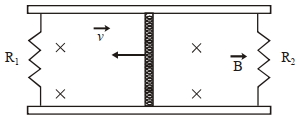
A conducting bar of length $L$ is free to slide on two parallel conducting rails as shown in the figure  Two resistors $R _{1}$ and $R _{2}$ are connected across the ends of the rails. There is a uniform magnetic field $\vec{B}$ pointing into the page. An external agent pulls the bar to the left at a constant speed $v$

The correct statement about the directions of induced currents $I _{1}$ and $I _{2}$ flowing through $R _{1}$ and $R _{2}$ respectively is

The plane faces of two identical plano-convex lenses each having focal length of $40 cm$ are pressed against each other to form a usual convex lens. The distance from this lens, at which an object must be placed to obtain a real, inverted image with magnification one is.......$cm$
A person can throw a ball upto a maximum range of $100 \,m$. How high above the ground he can throw the same ball?
Two charged spherical conductors of radius $R_{1}$ and $\mathrm{R}_{2}$ are connected by a wire. Then the ratio of surface charge densities of the spheres $\left(\sigma_{1} / \sigma_{2}\right)$ is :
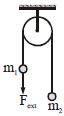
Two bodies of mass $m_1$ and $m_2$ $(m_2 > m_1)$ are connected by a light inextensible string which passes through a smooth fixed pulley. The instantaneous power delivered by an external agent to pull $m_1$ with constant velocity $v$ is
The Bulk Modulus for an incompressible liquid is