MCQ
In uniform circular motion
  • Both velocity and acceleration change
  • B
    Both velocity and acceleration are constant
  • C
    Velocity remains constant and acceleration changes
  • D
    Acceleration remains constant and velocity changes.

Answer

Correct option: A.
Both velocity and acceleration change
A

Need a full question paper?

Generate a complete, print-ready paper with questions like this in minutes — across 16+ boards, with answer keys.
Start Generating Free

Similar questions

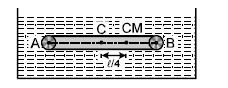
A non uniform cylinder of mass $m$ , length $l$ and radius $r$ is having its cetnre of mass at a distance $l/4$ from the centre and lying on the axis of the cylinder. The cylinder is kept in a liquid of uniform density $\rho $ . The moment of inertia of the rod about the centre of mass is $I$ . The angular acceleration of point $A$ relative to point $B$ just after the rod is released from the position shown in figure is
A $NCC$ parade is going at a uniform speed of $9\,km / h$ under a mango tree on which a monkey is sitting at a height of $19.6\,m$. At any particular instant, the monkey drops a mango. A cadet will receive the mango whose distance from the tree at time of drop is $...m$

(Given $g=9.8\,m / s ^{2}$ )

Acceleration due to gravity on moon is $\frac 16$ of the acceleration due to gravity on earth. If the ratio of densities of earth $({\rho _e})$ and moon $({\rho _m})$ is $\left( {\frac{{{\rho _e}}}{{{\rho _m}}}} \right) = \frac{5}{3}$ then radius of moon $R_m$ in terms of $R_e$ will be
If a stone is released from a ballon rising with acceleration $a$ at the instant when its velocity is $v$, then immediately after release, the acceleration and velocity of the stone are
A cricket ball of mass $250\, g$ collides with a bat with velocity $10 \,m/s$ and returns with the same velocity within $0.01 \,second$. The force acted on bat is ....... $N$
A particle performs harmonic oscillations along a straight line with a period of $6s$ and amplitude $4\ cm.$ The mean velocity of the particle averaged over the time interval during which it travels a distance of $2\ cm$ starting from the extreme position is:
Mark the correct statement :-
$Assertion$ : An astronaut experience weightlessness in a space satellite.

$Reason$ : When a body falls freely it does not experience gravity

At the top of the trajectory of a projectile, the acceleration is
A cyclist on a level road takes a sharp circular turn of radius $3 \;m \;\left( g =10 \;ms ^{-2}\right)$. If the coefficient of static friction between the cycle tyres and the road is $0.2$, at which of the following speeds will the cyclist not skid while taking the turn?