MCQ
In uniform circular motion
  • A
    Both the angular velocity and the angular momentum vary
  • B
    The angular velocity varies but the angular momentum remains constant
  • Both the angular velocity and the angular momentum stay constant
  • D
    The angular momentum varies but the angular velocity remains constant

Answer

Correct option: C.
Both the angular velocity and the angular momentum stay constant
c
(c) $L = I\omega .$

In U.C.M. $\omega$ =constant  $L =$ constant.

Need a full question paper?

Generate a complete, print-ready paper with questions like this in minutes — across 16+ boards, with answer keys.

Start Generating Free

Similar questions

A technician has only two resistance coils. By using them singly, in series or in parallel, he is able to obtain the resistance $3,4,12$ and $16 \,ohms$. The resistance of the two coils are ........... $ohms$
The activity of a freshly prepared radioactive sample is $10^{10}$ disintegrations per second, whose mean life is $10^9 s$. The mass of an atom of this radioisotope is $10^{-25} kg$. The mass (in $mg$ ) of the radioactive sample is
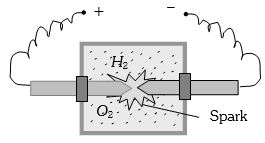
A vessel contains $14 \,gm \,(7 $ moles) of hydrogen and $96\, gm$ ($9$ moles) of oxygen at $STP.$ Chemical reaction is induced by passing electric spark in the vessel till one of the gases is consumed. The temperature is brought back to it's starting value $273 K.$ The pressure in the vessel is ...... $atm$
When $_{90}T{h^{228}}$ transforms to $_{83}B{i^{212}}$, then the number of the emitted  $\alpha$- and $\alpha$- particles is, respectively
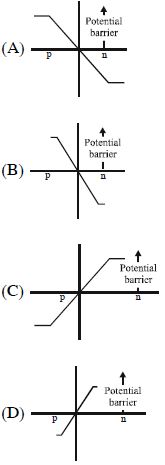
In a forward biased $p-n$ junction diode, the potential barrier in the depletion region will be of the form
A bomb is projected with $200\,m/s$ at an angle $60^o$ with horizontal. At the highest  point, it explodes into three particles of equal masses. One goes vertically upward with  velocity $100\,m/sec$, second particle goes vertically downward with the same velocity as  the first. Then what is the velocity of the third one-
Two magnets are held together in a vibration magnetometer and are allowed to oscillate in the earth’s magnetic field. With like poles of magnets together, $12\, oscillations$ per minute are made but for unlike poles together only $4\, oscillations$ per minute are executed. The ratio of their magnetic moments is
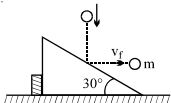
As shown in the figure $a$ body of mass $m$ moving vertically with speed $3\, m/s$ hits a smooth fixed inclined plane and rebounds with a velocity $v_f$ in the horizontal direction. If $\angle$ of inclined is $30^o$, the velocity $v_f$ will be
A carbonyl compound ${P}$, which gives positive iodoform test, undergoes reaction with $\mathrm{MeMgBr}$ followed by dehydration to give an olefin ${Q}$. Ozonolysis of ${Q}$ leads to a dicarbonyl compound ${R}$, which undergoes intramolecular aldol reaction to give predominantly ${S}$.

${P} \xrightarrow[\substack{\text { 2. } \mathrm{H}^{+}, \mathrm{H}_2 \mathrm{O} \\ \text { 3. } \mathrm{H}_2 \mathrm{SO}_4, \Delta}]{\text { 1. MeMgBr }}Q \xrightarrow[\text { 2. } \mathrm{Zn}, \mathrm{H}_2 \mathrm{O}]{1 . \mathrm{O}_3} {R} \xrightarrow[\text { 2. } \Delta]{1 . \mathrm{OH}^{-}} {S}$

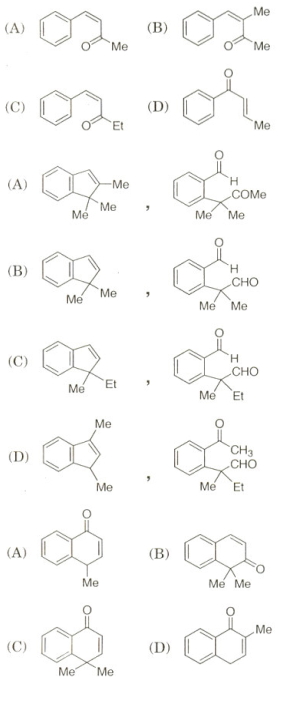
$1.$ The structure of the carbonyl compound ${P}$ is

$Image$

$2.$ The structures of the products ${Q}$ and ${R}$, respectively, are

$Image$

$3.$ The structure of the product ${S}$ is

$Image$

Give hte answer question $1,2$ and $3.$
$300$ Joule of work is done in sliding up a $2 \,kg$ block on an inclined plane to a height of $10\, metres$. Taking value of acceleration due to gravity $‘g’ $ to be $10 \,m/s^2$, work done against friction is ........ $J$