MCQ
In vacuum the speed of light depends upon
  • A
    Frequency
  • B
    Wave length
  • C
    Velocity of the source of light
  • None of these

Answer

Correct option: D.
None of these
d
( d)In vacuum speed of light is constant and is equal to $3 \times {10^8}m/s.$

Need a full question paper?

Generate a complete, print-ready paper with questions like this in minutes — across 16+ boards, with answer keys.

Start Generating Free

Similar questions

Assertion : $90_{\mathrm{Sr}}$ from the radioactive fall out from a nuclear bomb ends up in the bones of human beings through the milk consumed by them. It causes impairment of the production of red blood cells.
Reason : The energetics b-particles emitted in the decay of $90_{\mathrm{Sr}}$ damage the bone marrow.
Magnitude of magnetic field (in $SI$ units) at the centre of a hexagonal shape coil of side $10\, cm$, $50$ turns and carrying current $I$ (Ampere) in units of $\frac{\mu_{0} I}{\pi}$ is
The ratio of electric fields on the axis and at equator of an electric dipole will be
The transverse nature of light is shown by
A thin lens made of glass of refractive index m = 1.5 has a focal length equal to 12 cm in air. It is now immersed in water $\left(\mu=\frac{4}{3}\right)$. Its new focal length is
An electrons is revolving in $n =3$ orbit. What will be the magnetic field at the centre of hydrogen atom ? (in $T$)
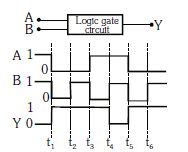
The following figure shows a logic gate circuit with two inputs $A $and $B$ and the output $Y$. The voltage waveforms of $A$, $B$, and $Y$ are as given? The logic gate is
A thin circular ring of mass M and radius r is rotating about its axis with an angular speed $\omega.$ Two particles having mass m each are now attached at diametrically opposite points. The angular speed of the ring will become:
Which law can ampere’s circuital be derived from?
In Young’s double slit experiment, the wavelength of the light used is doubled and distance between two slits is half of initial distance, the resultant fringe width becomes