MCQ
In Vander Waal’s equation $a$ and $b$ represent $\left( {P + \frac{a}{{{V^2}}}} \right)\,(V - b) = RT$
  • A
    Both $a$ and $b$ represent correction in volume
  • B
    Both $a$ and $b$ represent adhesive force between molecules
  • $a$ represents adhesive force between molecules and $b$ correction in volume
  • D
    $a$ represents correction in volume and $b$ represents adhesive force between molecules
Answer

Correct option: C.
$a$ represents adhesive force between molecules and $b$ correction in volume
c
$\left(P+\frac{a n^{2}}{V^{2}}\right)(v-n b)=n R T$

The constants $a$ and $b$ represents the magnitude of intermolecular attraction and excluded volume respectively, and are specific to a particular gas.

Correct choice - option - $C$

Need a full question paper?

Generate a complete, print-ready paper with questions like this in minutes — across 16+ boards, with answer keys.

Start Generating Free

Similar questions

To make the frequency double of an oscillator, we have to
We took two separate gases with the same number densities for both. If the ratio of the diameters of their molecules is 4 : 1, then ratio of their mean free paths is:
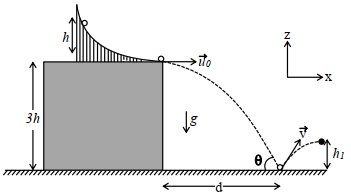
A slide with a frictionless curved surface, which becomes horizontal at its lower end,, is fixed on the terrace of a building of height $3 h$ from the ground, as shown in the figure. A spherical ball of mass $\mathrm{m}$ is released on the slide from rest at a height $h$ from the top of the terrace. The ball leaves the slide with a velocity $\vec{u}_0=u_0 \hat{x}$ and falls on the ground at a distance $d$ from the building making an angle $\theta$ with the horizontal. It bounces off with a velocity $\overrightarrow{\mathrm{v}}$ and reaches a maximum height $h_l$. The acceleration due to gravity is $g$ and the coefficient of restitution of the ground is $1 / \sqrt{3}$. Which of the following statement($s$) is(are) correct?

($AV$) $\vec{u}_0=\sqrt{2 g h} \hat{x}$ ($B$) $\vec{v}=\sqrt{2 g h}(\hat{x}-\hat{z})$  ($C$) $\theta=60^{\circ}$  ($D$) $d / h_1=2 \sqrt{3}$

A balloon was moving upwards with a uniform velocity of $10\, {m} / {s}$. An object of finite mass is dropped from the balloon when it was at a height of $75\, {m}$ from the ground level. The height of the balloon from the ground when object strikes the ground was around.(In ${m}$) (Takes the value of $g$ as $10 \,{m} / {s}^{2}$ )
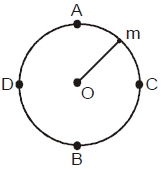
A mass is performing vertical circular motion (see figure). If The average velocity of the particle is increased, then at which point the string will break
A monoatomic gas performs a work of $\frac{Q}{4}$ where $Q$ is the heat supplied to it. The molar heat capaticy of the gas will be $R$ during this transformation. Where $R$ is the gas constant.
$A$ uniform disc is rolling on a horizontal surface. At a certain instant $B$ is the point of contact and $A$ is at height $2R$ from ground, where $R$ is radius of disc.
A ball is made of a material of density $\rho$ where $\rho_{oil} < \rho < \rho_{water}$ with $\rho_{oil}$ and $\rho_{water}$ representing the densities of oil and water, respectively. The oil and water are immiscible. If the above ball is in equilibrium in a mixture of this oil and water, which of the following pictures represents its equilibrium position?
A mass of 1kg attached to the bottom of a spring has a certain frequency of vibration. The following mass has to be added to it in order to reduce the frequency by half:
A physical quantity of the dimensions of length that can be formed out of $c, G$ and $\frac{e^2}{4\pi \varepsilon _0}$  is $[c$ is velocity of light, $G$ is the universal constant of gravitation and $e$ is charge $] $