Question
In what condition does a charged particle moving through a magnetic field follow a circular path?
Answer

The charged particle follows a circular path, when it moves perpendicular to the direction of a magnetic field.

Need a full question paper?

Generate a complete, print-ready paper with questions like this in minutes — across 16+ boards, with answer keys.

Start Generating Free

Similar questions

A metal block of density $6000 \mathrm{~kg} \mathrm{~m}^{-3}$ and mass 1.2 kg is suspended through a spring of spring constant $200 \mathrm{~N} \mathrm{~m}^{-1}$. The spring-block system is dipped in water kept in a vessel. The water has a mass of 260 g and the block is at a height 40 cm above the bottom of the vessel. If the support to the spring is broken, what will be the rise in the temperature of the water. Specific heat capacity of the block is $250 \mathrm{Jkg}^{-1} \mathrm{~K}^{-1}$ and that of water is $4200 \mathrm{Jkg}^{-1} \mathrm{~K}^{-1}$. Heat capacities of the vessel and the spring are negligible.
Why is it difficult to walk on solid ice?
Name the dielectric whose molecules have:
  1. Non-zero,
  2. Zero dipole moment.
Consider a book lying on a table. The weight of the book and the normal force by the table on the book are equal in magnitude and opposite in direction. Is this an example of Newton's third law?
In a circuit containing a capacitor and an AC source the current is zero at the. stant the source voltage is maximum. Is it consistent with Ohm's law?
A convex lens with a refractive index is placed in that medium whose refractive index is equal to the refractive index of the lens. What will be the focal length of the lens in this medium?
Is it possible that the terminal potential difference across the cell be zero? If yes, state the condition.
Does the electric potential increase or decrease along the line of electric force?
The plates of a parallel-plate capacitor are given equal positive charges. What will be the potential difference between the plates? What will be the charges on the facing surfaces and on the outer surfaces?
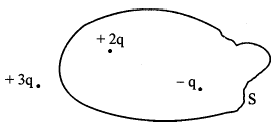
Figure shows three point charges, + 2q, – q and + 3q. Two charges + 2q and – q are enclosed within a surface ‘S’. What is the electric flux due to this configuration through the surface ‘S’?