Question
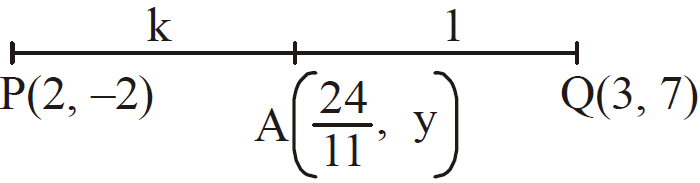
In what ratio does point$\Big(\frac{24}{11},\text{y}\Big)$ divide the line segment joining the points P(2, -2) and Q(3, 7)? Also, find the value of y.
Answer


Let PA : AQ = k : 1
$\therefore \frac{2 + 3\text{k}}{\text{k + 1}} = \frac{24}{11}$
$\Rightarrow \text{k} = \frac{2}{9}$
Hence the ratio is 2 : 9.
Therefore $\text{y} = \frac{-18 + 14}{11} = \frac{-4}{11}$

Need a full question paper?

Generate a complete, print-ready paper with questions like this in minutes — across 16+ boards, with answer keys.
Start Generating Free

Similar questions

Show that $A (1, 2) , (1, 6), C (1+2 \sqrt{3}, 4)$ are vertices of an equilateral triangle.
Prove the following : The measure of an inscribed angle is half of the measure of the arc intercepted by it.
Solve for x and y:
$\frac{\text{2x}+\text{5y}}{\text{xy}}=6,$
$\frac{\text{4x}-\text{5y}}{\text{xy}}=-3$
Roshani saw an eagle on the top of a tree at an angle of elevation of 61°, while she was standing at the door of her
house. She went on the terrace of the house so that she could see it clearly. The terrace was at a height of 4m. While
observing the eagle from there the angle of elevation was 52°. At what height from the ground was the eagle ?
(Find the answer correct upto nearest integer)
(tan 61° = 1.80, tan 52° = 1.28, tan 29° = 0.55, tan 38° = 0.78)
Show that the following points are the vertices of a square:
P(0, -2), Q(3, 1), R(0, 4) and S(-3, 1)
If A (20, 10), B(0, 20) are given, find the coordinates of the points which divide segment AB into five congruent parts.

Image
A straight highway leads to the foot of a tower. A man standing on the top of the tower observes a car at an angle of depression of 30°, which is approaching the foot of the tower with a uniform speed. Six secounds later, the angle of depression of the car is fo d to be 60°. Find the time taken by the car to reach the foot of the tower form this point.
The radii of the ends of a bucket $30\ cm$ high are $21\ cm$ and $7\ cm$. Find its capacity in litres and the amount of sheet required to make this bucket.
Solve the following equations by using the method of completing the square:
$\text{4x}^2+4\sqrt3+3=0$