MCQ
In which alkyl halide, $S{N^2}$ mechanism is favoured maximum
  • $C{H_3}Cl$
  • B
    $C{H_3}C{H_2}Cl$
  • C
    ${(C{H_3})_2}CHCl$
  • D
    ${(C{H_3})_3}C - Cl$

Answer

Correct option: A.
$C{H_3}Cl$
a
(a)  ${S_{{N^2}}}$ Substitution nucleophilic bimolecular order of different alkyl halides. ${1^o} > {2^o} > {3^o}$

${S_{{N^1}}}$ Substitution nucleophilic unimolecular order of different alkyl halides , ${3^o} > {2^o} > {1^o}$.

Need a full question paper?

Generate a complete, print-ready paper with questions like this in minutes — across 16+ boards, with answer keys.

Start Generating Free

Similar questions

Of the ions $Z{n^{2 + }},$ $N{i^{2 + }}$ and $C{r^{3 + }}$[atomic number of $Zn = 30,$ $Ni = 28,$ $Cr = 24$
Which of these alkyl halides can be used to prepare amines using Gabriel phthalimide synthesis?
In the catalytic oxidation of ammonia an oxide is formed which is used in the preparation of $HN{O_3}$. This oxide is
One of the acid listed below is formed from ${P_2}{O_3}$ and the rest are formed from ${P_2}{O_5}$. The acid formed from phosphorus $(III)$ oxide is
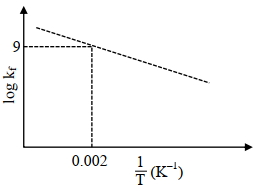
The plot of $\log \mathrm{k}_f$ versus $1 / \mathrm{T}$ for a reversible reaction $\mathrm{A}(\mathrm{g}) \rightleftharpoons \mathrm{P}(\mathrm{g})$ is shown.

(Image)

Pre-exponential factors for the forward and backward reactions are $10^{15} \mathrm{~s}^{-1}$ and $10^{11} \mathrm{~s}^{-1}$, respectively. If the value of $\log \mathrm{K}$ for the reaction at $500 \mathrm{~K}$ is $6$ , the value of $\left|\log \mathrm{k}_{\mathrm{b}}\right|$ at $250 \mathrm{~K}$ is $\qquad$

$[\mathrm{K}=$ equilibrium constant of the reaction

$\mathrm{k}_{\mathrm{f}}=$ rate constant of forward reaction

$\mathrm{k}_{\mathrm{b}}=$ rate constant of backward reaction]

What is the freezing point of a solution containing $8.1\,g\,\,HBr$ in $100\,g$ water assuming the acid to be $90\,%$ ionised $({K_f}$ for water $ = 1.86\,K\,mol{e^{ - 1}})$ ............. $^oC$
Which of the glycosidic linkage between galactose and glucose is present in lactose ?
Product which is not expected to be formed is
Dehydrohalogenation of an alkyl halide is
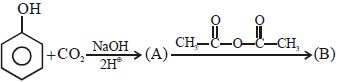
Product $(A)$ and $(B)$ respectively are :-