MCQ
In which case does the potential energy decrease?
  • A
    On compressing the spring.
  • B
    On stretching a spring.
  • C
    On moving a body against gravitational pull.
  • D
    On the raising of an air bubble in water.

Answer

  1. On the raising of an air bubble in water.

Explanation:

P.E. decreases when an air bubble rises in water. Because work is done by upthrust.

Need a full question paper?

Generate a complete, print-ready paper with questions like this in minutes — across 16+ boards, with answer keys.
Start Generating Free

Similar questions

An insulated container contains $4\, moles$ of an ideal diatomic gas at temperature $T$. Heat $Q$ is supplied to this gas, due to which $2\, moles$ of gas are dissociated into  atoms but temperature of the gas remains constant. Then:
The coordinates of a moving particle at any time $‘t’$ are given by $ x = \alpha t^3$ and $y = \beta t^3$. The speed of the particle at time $‘t’$ is given by
In practice, all heat engines have efficiency less than that of a Carnot engine because
Two equal masses are attached to the two ends of a spring of spring constant k. The masses are pulled out symmetrically to stretch the spring by a length x over its natural length. The work done by the spring on each mass is:
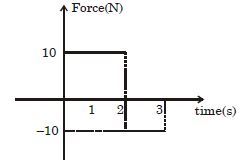
A $2\ kg$ object is floating at rest, acted upon by only force as indicated in figure. Find the total work done by the force in $3\ sec$ ..................... $\mathrm{J}$
Which of the following physical quantities has a unit but no dimensions ?
The equation $\text{y}=\text{A}\sin^2(\text{kx}-\omega\text{t})$ represents a wave motion with:
  1. Amplitude A, frequency $\frac{\omega}{2\pi}$
  2. Amplitude $\frac{\text{A}}{2},$ frequency $\frac{\omega}{\pi}$
  3. Amplitude 2A, frequency $\frac{\omega}{4\pi}$
  4. Does not represent a wave motion.
Scent sprayer is based on
A force $F$ is needed to break a copper wire having radius $R.$ The force needed to break a copper wire of radius $2R$ will be
A particle moves towards east with velocity $5\ m/s$ . After $10\ seconds$ its direction changes towards north with same velocity. The average acceleration of the particle is