MCQ
In which case, work done will be zero:
  • A
    A weight-lifter while holding a weight of 100kg on his shoulders for 1min.
  • B
    A locomotive against gravity when it is running on a level plane with a speed of 60kmh-1.
  • C
    A person holding a suitcase on his head and standing at a bus terminalAll of the above.
  • D
    All of the above.

Answer

  1. All of the above.

Explanation:

Work done by weight-lifter is zero because there is no displacement. In a locomotive, work done is zero because force and displacement are mutually perpendicular to each other.

While a person holding a suitcase, work done is zero because there is no displacement.

Need a full question paper?

Generate a complete, print-ready paper with questions like this in minutes — across 16+ boards, with answer keys.

Start Generating Free

Similar questions

A uniform cylinder of length $L$ and mass $M$ having cross-sectional area $A$ is suspended, with its length vertical, from a fixed point by a massless spring, such that it is half submerged in a liquid of density $\sigma $ at equilibrium position. When the cylinder is given a downward push and released, it starts oscillating vertically with a small amplitude. The time period $T$ of the oscillations of the cylinder will be
A perfect gas goes from state $A$ to another state $B$ by absorbing $8 \times {10^5}J$ of heat and doing $6.5 \times {10^5}J$ of external work. It is now transferred between the same two states in another process in which it absorbs ${10^5}J$ of heat. Then in the second process
In a thermodynamic process two moles of a monatomic ideal gas obeys $P \propto V^{-2}$. If temperature of the gas increases from $300 \,K$ to $400 \,K$, then find work done by the gas .........$R$ (where $R=$ universal gas constant).
A bullet of mass $0.1\,kg$ moving horizontally with speed $400\,ms ^{-1}$ hits a wooden block of mass $3.9\,kg$ kept on a horizontal rough surface. The bullet gets embedded into the block and moves $20\,m$ before coming to rest. The coefficient of friction between the block and the surface is $........$ $\left(\text { Given } g=10 \,ms ^2\right. \text { ) }$
A cart is moving horizontally along a straight line with a constant speed of $30\,m / s$. A projectile is to be fired from the moving cart in such a way that it will retum to the cart (at the same point on cart) after the cart has moved $80\,m$. At what velocity (relative to the cart) must be projectile be fired? (Take $=10\,m / s ^2$ )
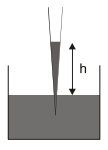
A glass capillary tube is of the shape of a truncated cone with an apex angle $\alpha$ so that its two ends have cross sections of different radii. When dipped in water vertically, water rises in it to a height $h$, where the radius of its cross section is $b$. If the surface tension of water is $S$, its density is $\rho$, and its contact angle with glass is $\theta$, the value of $h$ will be ( $g$ is the acceleration due to gravity)
Two vibrating tuning forks produce progressive waves given by ${y_1} = 4\,\sin \,\left( {500\pi t} \right)$ and ${y_2} = 2\,\sin \,\left( {506\pi t} \right)$. These tuning forks are held near the ear of a person. The person will hear $\alpha \, beats/s$ with intensity ratio between maxima and minima equal to $\beta $. Find the value of $\beta  - \alpha $
Mark the correct statements:
  1. The magnitude of the velocity of a particle is equal to its speed.
  2. The magnitude of average velocity in an interval is equal to its average speed in that interval
  3. It is possible to have a situation in which the speed of a particle is always zero but the average speed is not zero.
  4. It is possible to have a situation in which the speed of the particle is never zero but the average speed in an interval is zero.
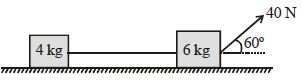
The tension in the string which connected the blocks as shown in the following figure  ............ $ N$
A boy is standing on top of a tower of height $85 \,m$ and throws a ball in the vertically upward direction with a certain speed. If $5.25$ s later he hears the ball hitting the ground, then the speed with which the boy threw the ball is .......... $m / s$ (take, $g=10 \,m / s ^2$ and speed of sound in air $=340 \,m / s$ )