A wide range of contraceptive methods are presently available which could be broadly grouped into the following categories, namely :
1. Natural/Traditional,
2. Barrier,
3. IUDs,
4. Oral contraceptives,
5. Injectables,
6. Implants and
7. Surgical methods.
(1) Natural/Traditional Methods : These methods work on the principle sperms meeting. These include followings :
A. Periodie abstinence is one such method in which the couples avoid or abstain from coitus from day 10 to 17 of the menstrual cycle when ovulation could be expected. As chances of fertilisation are very high during this period, it is called the fertile period. Therefore, by abstaining from coitus during this period, conception could be prevented.
B. Withdrawal or coitus interruptus is another method in which the male partner withdraws his penis from the vagina just before ejaculation so as to avoid insemination.
C. Lactational amenorrhea (absence of menstruation) method is based on the fact that ovulation and therefore the cycle do not occur during the period of intense lactation following parturition. Therefore, as long as the mother breast-feeds the child fully, chances of conception are almost nil. However, this method has been reported to be effective only upto a maximum period of six months following parturition. As no medicines or devices are used in these methods, side effects are almost nil. Chances of failure, though, of this method are also high.
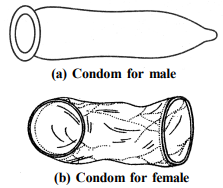
(2) Barrier Methods : In these methods, ovum and sperms are prevented from physically meeting with the help of barriers. Such methods are available for both males and females. Condoms [Fig. (a), (b)] are barriers made of thin rubber/latex sheath that are used to cover the penis in the male or vagina and cervix in the female, just before coitus so that the ejaculated semen would not enter into the female reproductive tract. This can prevent conception.
‘Nirodh’ is a popular brand of condom for the male. Use of condoms has increased in recent years due to its additional benefit of protecting the user from contracting STIs and AIDS.
Both the male and the female condoms are disposable, can be self-inserted and thereby gives privacy to the user.
Diaphragms, cervical caps and vaults are also barriers made of rubber that are inserted into the female reproductive tract to cover the cervix during coitus. They prevent conception by blocking the entry of sperms through the cervix. They are reusable. Spermicidal creams, jellies and foams are usually used alongwith these barriers to increase their contraceptive efficiency.
 (3) Intra Uterine Devices (IUDs) :
 Another effective and popular method is the use of Intra Uterine Devices (IUDs). These devices are inserted by doctors or expert nurses in the uterus through vagina. These Intra Uterine Devices are presently available as the non-medicated IUDs (e.g., Lippes loop), copper releasing IUDs (CuT, Cu7, Multiload 375) and the hormone releasing IUDs (Progestasert, LNG-20) (Fig. 3.2). IUDs increase phagocytosis of sperms within the uterus and the Cu ions released suppress sperm motility and the fertilising capacity of sperms. The hormone releasing IUDs, in addition, make the uterus unsuitable for implantation and the cervix hostile to the sperms. IUDs are ideal contraceptives for the females who want to delay pregnancy and/or space children. It is one of most widely accepted methods of contraception in India.
Oral administration of small doses of either progestrone or progestrone-estrogen combinations is another contraceptive method used by the females. They are used in the form of tablets and hence are popularly called the pills. Pills have to be taken daily for a period of 21 days starting preferably within the first five days of menstrual cycle. After a gap of 7 days (during which menstruation occurs) it has to be repeated in the same pattern till the female desires to prevent conception. They inhibit ovulation and implantation as well as alter the quality of cervical mucus to prevent/retard entry of sperms. Pills are very effective with lesser side effects and are well accepted by the females. Saheli—the new oral contraceptive for the females contains a non-steroidal preparation. It is a 'once a week' pill with very few side effects and high contraceptive value. Progestrone alone or in combination with estrogen can also be used by females as injections or implants under the skin (Fig. 3.3). Their mode of action is similar to that of pills and their effective periods are much longer. Administration of progestron or progestrone-estrogen combinations or IUDs within 72 hours of coitus have been found to be very effective as emergency contraceptives as they could be used to avoid possible pregnancy due to rape or casual unprotected intercourse.