MCQ
In which $O-O$ bond distance is minimum
- APotasium superoxide
- BSodium peroxide
- CHydrogen peroxide
- ✓Dioxygen
Generate a complete, print-ready paper with questions like this in minutes — across 16+ boards, with answer keys.
$3 \mathrm{PbCl}_2+2\left(\mathrm{NH}_4\right)_3 \mathrm{PO}_4 \rightarrow \mathrm{Pb}_3\left(\mathrm{PO}_4\right)_2+6 \mathrm{NH}_4 \mathrm{Cl}$
If $72 \mathrm{mmol}$ of $\mathrm{PbCl}_2$ is mixed with $50 \mathrm{mmol}$ of$\left(\mathrm{NH}_4\right)_3 \mathrm{PO}_4$, then amount of $\mathrm{Pb}_3\left(\mathrm{PO}_4\right)_2$ formed is......... mmol. (nearest integer)
$\mathrm{A}(\mathrm{g}) \rightarrow 2 \mathrm{~B}(\mathrm{~g})+\mathrm{C}(\mathrm{g})$
If the total pressure of the gases is found to be $200$ torr after $23 \mathrm{sec}$. and $300$ torr upon the complete decomposition of $\mathrm{A}$ after a very long time, then the rate constant of the given reaction is . . . . . .$\times 10^{-2} \mathrm{~s}^{-1}$ (nearest integer)
[Given : $\log _{10}(2)=0.301$ ]
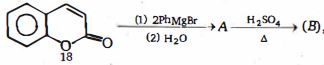
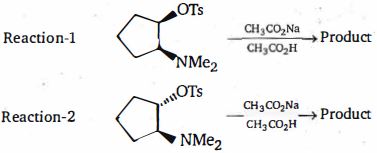
$A$ and $B$ are