MCQ
In which of the following arrangements, the order is not correct according to the property indicated against it
  • A
    Increasing size :  $Al^{3+} < Mg^{2+} < Na^+ < F^-$
  • Increasing  $IE_1$ :  $B < C < N < O$
  • C
    Increasing  $EA_1$  :  $I < Br < F < Cl$
  • D
    Increasing metallic radius  :  $Li < Na < K < Rb$
Answer

Correct option: B.
Increasing  $IE_1$ :  $B < C < N < O$
b
In the arrangement of the option $B$, the order is not correct according to the property indicated against it.

The correct order for increasing first ionisation energy is $B \,<\, C \,<\, O \,< \,N$.

The ionisation energy of $N$ is higher than the ionisation energy of $O$. This is because, in case of $N$, the removal of an electron will break stable half-filled electronic configuration of $2 p$ subshell.

Need a full question paper?

Generate a complete, print-ready paper with questions like this in minutes — across 16+ boards, with answer keys.

Start Generating Free

Similar questions

The oxidation state of chromium in the final product formed in the reaction between $KI$ and acidified potassium dichromate solution is:
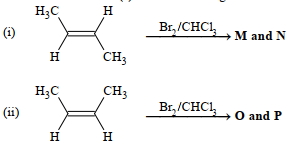
The correct statement(s) for the following addition reactions is(are)

(IMAGE)

$[A]$ ( $M$ and $O)$ and ( $N$ and $P$ ) are two pairs of diastereomers

$[B]$ Bromination proceeds through trans-addition in both the reactions

$[C]$ $O$ and $P$ are identical molecules

$[D]$ (M and $O)$ and ( $N$ and $P)$ are two pairs of enantiomers

For the system $A_{(g)} + 2B_{(g)}$ $\rightleftharpoons$ $C_{(g)}$, the equilibrium concentrations are $(A) 0.06$ mole/litre $(B) 0.12$ mole/litre $(C) 0.216$ mole/litre. The ${K_{eq}}$ for the reaction is
In Carius method of estimation of halogen, $0.172\, g$ of an organic compound showed presence of $0.08\, g$ of bromine. Which of these is the correct structure of the compound:
The internal energy change (in $J$ ) when $90\, g$ of water undergoes complete evaporation at $100^{\circ} C$ is........

(Given: $\Delta H _{\text {vap }}$ for water at $373\, K =41\, kJ / mol$, $\left. R =8.314\, JK ^{-1} mol ^{-1}\right)$

The reaction of $HBr$ with the following compound would produce
The two electrons in $K $ sub-shell will differ in
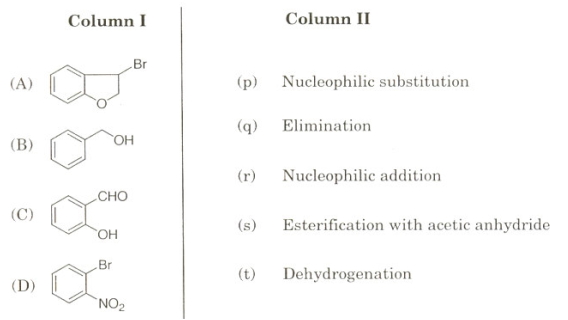
Match each of the compounds given in Column $I$ with the reaction$(s)$, that they can undergo, given in Column $II$.
The conversion of sugar ${C_{12}}{H_{22}}{O_{11}}\, \to \,\,C{O_2}$ is
Number of molecules from the following which can exhibit hydrogen bonding is . . . . . . . (nearest integer)