MCQ
In which of the following compound hyperconjugation effect is not present
- ✓
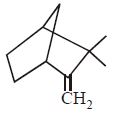
- B
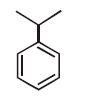
- C$CH_3-CH=CH_2$
- D
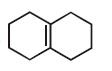
Generate a complete, print-ready paper with questions like this in minutes — across 16+ boards, with answer keys.
$STATEMENT-2$: Both geometrical isomers of the complex $\left[\mathrm{M}\left(\mathrm{NH}_3\right)_4 \mathrm{Cl}_2\right]$ possess axis of symmetry.
$\mathop {\begin{array}{*{20}{c}}
{\begin{array}{*{20}{c}}
{COOH\,\,} \\
{|\,\,\,\,\,\,\,\,\,\,\,\,\,\,\,} \\
{H - C - OH\,\,\,\,\,\,\,\,\,\,\,} \\
{|\,\,\,\,\,\,\,\,\,\,\,\,\,\,\,}
\end{array}} \\
{Br - C - H\,\,\,\,\,\,\,\,\,\,\,\,\,\,\,\,\,} \\
{|\,\,\,\,\,\,\,\,\,\,\,\,\,\,\,\,\,} \\
{\,\,\,COOC{H_3}}
\end{array}}\limits_{(I)} $ $\mathop {\begin{array}{*{20}{c}}
{\begin{array}{*{20}{c}}
{\,\,\,\,\,\,\,\,COOC{H_3}\,\,} \\
{|\,\,\,\,\,\,\,\,\,\,\,\,\,\,\,} \\
{H - C - Br\,\,\,\,\,\,\,\,\,\,\,} \\
{|\,\,\,\,\,\,\,\,\,\,\,\,\,\,\,}
\end{array}} \\
{HO - C - H\,\,\,\,\,\,\,\,\,\,\,\,\,\,\,\,\,} \\
{\,\,|\,\,\,\,\,\,\,\,\,\,\,\,\,\,\,\,\,} \\
{\,\,\,\,\,\,\,COOH\,\,\,\,\,\,\,\,}
\end{array}}\limits_{(II)} $
$Cu^+ /Cu = + 0.52\, V$,
$Fe^{3+} /Fe^{2+} = +0.7 7\, V$,
$\frac{1}{2}{I_2}\left( s \right)/{I^ - }\, = + 0.54\,V,$
$Ag^+ /Ag = + 0.88\,V$.
Based on the above potentials, strongest oxidizing agent will be
$Benzene$ $\xrightarrow{HCHO+HCl}\,A$$\xrightarrow{AgCN}\,B$