Question
In which of the following decay, the element does not change

Answer

(c) As the $\gamma - $ particle has no charge and mass.

Need a full question paper?

Generate a complete, print-ready paper with questions like this in minutes — across 16+ boards, with answer keys.
Start Generating Free

Similar questions

In a photo-emissive cell, with exciting wavelength $\lambda$ , the maximum kinetic energy of electron is $K$. If the exciting wavelength is changed to $\frac{3\lambda}{4}$ the kinetic energy of the fastest emitted electron will be:
$10\  m$ is the total mass of a cannon that includs  all shell. Initial cannon is moving with velocity $10\  m$ is along a horizontal frictionless path. If cannon fires $'n$' shells of mass $m$ in the direction of motion of the cannon one by one with velocity $u$ with respect to ground. (neglect any friction force)
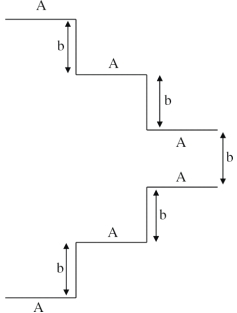
A paralle plate capacitor is made up of stair like structure with a palte area $A$ of each stair and that is connected with a wire of length $b$, as shown in the figure. The capacitance of the arrangement is $\frac{ x }{15} \frac{\varepsilon_{0} A }{ b }$. The value of $x$ is ............
The electron emitted in beta radiation originates from
A metal surface of work function $1.07 eV$ is irradiated with light of wavelength $332 nm$. The retarding potential required to stop the escape of photo-electrons is .............. $eV$
The relative uncertainty in the period of a sateilite orbiting around the earth is $10^{-2}$. If the relative uncertainty in the radius of the orbit is negligible, the relative uncertainty in the mass of the earth is
A beam of ions with velocity $2 \times {10^5}\,m/s$ enters normally into a uniform magnetic field of $4 \times {10^{ - 2}}\,tesla$. If the specific charge of the ion is $5 \times {10^7}\,C/kg$, then the radius of the circular path described will be.......$m$
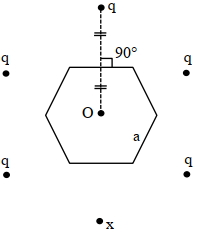
Six charges are placed around a regular hexagon of side length a as shown in the figure. Five of them have charge $q$, and the remaining one has charge $x$. The perpendicular from each charge to the nearest hexagon side passes through the center $O$ of the hexagon and is bisected by the side.

Which of the following statement($s$) is(are) correct in SI units?

$(A)$ When $x=q$, the magnitude of the electric field at $O$ is zero.

$(B)$ When $x=-q$, the magnitude of the electric field at $O$ is $\frac{q}{6 \pi \in_0 a^2}$.

$(C)$ When $x=2 q$, the potential at $O$ is $\frac{7 q}{4 \sqrt{3} \pi \in_0 a}$.

$(D)$ When $x=-3 q$, the potential at $O$ is $\frac{3 q}{4 \sqrt{3} \pi \in_0 a}$.
Different physical quantities are given in Column - $\mathrm{I}$ and their dimensional formula are given in Column - $\mathrm{II}$. Match them appropriately.
Column - $\mathrm{I}$ Column - $\mathrm{II}$
$(a)$ Viscous force $(i)$ $\left[ {{M^1}{L^1}{T^{ - 2}}} \right]$
$(b)$ Coefficient of viscosity $(ii)$ $\left[ {{M^1}{L^{ - 1}}{T^{ - 1}}} \right]$
  $(iii)$ $\left[ {{M^1}{L^{ - 1}}{T^{ - 2}}} \right]$
Fraunhofer spectrum is a