Question
In which of the following decays the element does not change?

Answer

  1. $\gamma-\text{decay}$
Explanation:
In alpha particle decay, the unstable nucleus emits an alpha particle reducing its proton number Z by 4 and neutron number N by 2 such that the element gets changed.
$\text{ }^{\text{A}}_{\text{Z}}\text{X}\rightarrow\text{ }^{\text{A}-4}_{\text{Z}-2}\text{Y}+\text{ }^4_2\text{He}$
During $\beta^--\text{decay},$ a neutron is converted to a proton​, an electron and an antineutrino, i.e. an active nucleus gets converted to one of its isobars and hence the element gets changed.
$\text{ }^{\text{A}}_{\text{Z}}\text{X}\rightarrow\text{ }^{\text{A}}_{\text{Z}+1}\text{Y}+\text{e}+\bar{\text{v}}$
During $\beta^+-\text{decay},$ a proton in the nucleus is converted to a neutron​, a positron and a neutrino in order to maintain the stability of the nucleus, i.e. an active nucleus gets converted to one of its isobars and hence the element gets changed.
$\text{ }^{\text{A}}_{\text{Z}}\text{X}\rightarrow\text{ }^{\text{A}}_{\text{Z}-1}\text{Y}+\beta^++\text{v}$
When a nucleus is in higher excited state or has excess of energy, it comes to the ground state in order to become stable and release energy in the form of electromagnetic radiation called gamma ray. Hence, the element in gamma decay doesn't change.

Need a full question paper?

Generate a complete, print-ready paper with questions like this in minutes — across 16+ boards, with answer keys.
Start Generating Free

Similar questions

Two equal positive charges are kept at points A and B. The electric potential at the points between A and B (excluding these points) is studied while moving from A to B. The potential.
  1. Continuously increases.
  2. Continuously decreases.
  3. Increases then decreases.
  4. Decreases then increases.
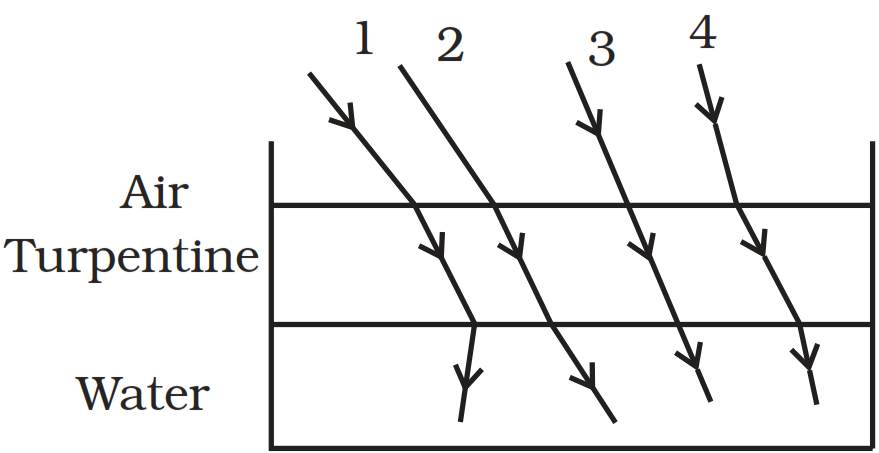
The optical density of turpentine is higher than that of water while its mass density is lower. Fig. shows a layer of turpentine floating over water in a container. For which one of the four rays incident on turpentine in Fig, the path shown is correct?
When a certain length of wire is turned into one circular loop, the magnetic induction at the centre of coil due to some current flowing is $B_1$ If the same wire is turned into three loops to make a circular coil, the magnetic induction at the center of this coil for the same current will be
The minimum temperature of a body at which it emits light is(a) 1200°C (b) 1000°C(c) 500°C (d) 200°C
       
The electric potential at the surface of an atomic nucleus $(Z=50)$ of radius $9.0 \times 10^{-13} cm$ is
Resistance in the two gaps of a meter bridge are 10 ohm and 30 ohm respectively. If the resistances are interchanged the balance point shifts by(a) 33.3 cm(b) 66.67cm(c) 25 cm(d) 50 cm
       
Which of the following can be chosen to analogously represent the behavior of a particle?
In hard X-rays :
An α -particle is accelerated through a potential difference of 200V. The increase in its kinetic energy is (a) 100 eV(b) 200 eV(c) 400 eV(d) 800 eV
       
Light waves producing interference have their amplitudes in the ratio 3 : 2. The intensity ratio of maximum and minimum of interference fringes is(a) 36 : 1 (b) 9 : 4(c) 25 : 1 (d) 6 : 4