MCQ
In which of the following molecules/ions $BF_3 , NO_2^- , NH_2^-$ and $H_2O,$ the central atom is $sp^2$ hybridised?
- A$NH_2^-$ and $H_2O$
- B$NO_2^-$ and $H_2O$
- ✓$BF_3$ and $NO_2^-$
- D$NO_2^-$ and $NH_2^-$
In BF $_{3}$ molecule, a number of $\sigma$ bond is $3$ ie, $sp^{2}$ hybridization.
In $\mathrm{NO}_{2}^-$ molecule, the number of $\sigma$ bond is $2$ and the number of lone pairs is $2$ ie, $sp^3$ hybridization.
In $\mathrm{NH}_{2}$ molecule, the number of $\sigma$ bond is $2$ and the number of lone pairs is $2$ ie, $sp^{3}$ hybridization.
In $\mathrm{H}_{2} \mathrm{O}$ molecule, the number of $\sigma$ bond is $2$ and number of the lone pair are $2$ ie, $sp ^{3}$ hybridization.
Thus, in $\mathrm{BF}_{3}$ and $\mathrm{NO}_{2}$ - central atom is $\mathrm{sp}^{2}$ hybridised.
Generate a complete, print-ready paper with questions like this in minutes — across 16+ boards, with answer keys.
Assertion $(A)$: Cis form of alkene is found to be more polar than the trans form
Reason $(R)$: Dipole moment of trans isomer of $2$-butene is zero.
In the light of the above statements, choose the correct answer from the options given below :
$2H_2(g) + O_2(g) \to 2H_2O(l)$ ; $\Delta _fH^o_{298}(H_2O(l)) = -285.5\, kJ/mol$
What is $\Delta S^o_{298}$ for the given fuel cell reaction ?
Given $: O_2(g) + 4H^+(aq) + 4e^- \to 2H_2O(l)$ $E^o = 1.23\, V$
$\frac{3}{2} \mathrm{O}_{2(\mathrm{~g})} \rightleftharpoons \mathrm{O}_{3(\mathrm{~g})} \cdot \mathrm{K}_{\mathrm{P}}=2.47 \times 10^{-29} \text {. }$
$\Delta_{\mathrm{r}} \mathrm{G}^{\ominus}$ for the reaction is_______ $kJ$. (Given R $\left.=8.314 \mathrm{JK}^{-1} \mathrm{~mol}^{-1}\right)$
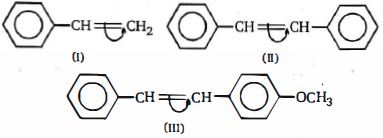
$1.\,\,(CH_3)_2 - \mathop C\limits^ + - CH_2 - CH_3$
$2.\,\,(CH_3)_3 - \mathop C\limits^ + $
$3.\,\,(CH_3)_2 - |\mathop C\limits^ + H|$
$4.\,\,CH_3 - \mathop C\limits^ + H_2$
$5.\,\,\mathop C\limits^ + H_3$