MCQ
In which of the following statement is or are incorrect$?$
  • A
    Nylon was made in the year $1931.$
  • Nylon developed in netherlands and london.
  • C
    Nylon is not attacked by moths and ordinary chemicals.
  • D
    Nylon fibre have high abrasion resistance.

Answer

Correct option: B.
Nylon developed in netherlands and london.

 The name nylon comes from the fact that it was developed in new york (ny) and london (lon).

Need a full question paper?

Generate a complete, print-ready paper with questions like this in minutes — across 16+ boards, with answer keys.
Start Generating Free

Similar questions

Which of the following can be charged by rubbing?
What are pseudopodia?
Assertion (A) Night birds have more rods than cones.
Reason (R) Rods are more sensitive for dim light than cones.
Sujit took four different beakers $I, II, III,$ and $IV$ each containing $1$ litre water. Also, he took four fuels $W, X, Y,$ and $Z$. Then, he started heating the water in beakers $I, II, III,$ and $IV$ using $1kg$ of each $W, X, Y,$ and $Z$ respectively.He found out that the heat produced by complete combustion of $2kg$ of $W, 4kg$ of $X, 1.2kg$ of $Y,$ and $3.2kg$ of $Z$ is $110000\ kJ, 100000\ kJ, 72000\ kJ,$ and $12800\ kJ$ respectively. Assume that all the heat released by burning the fuel is absorbed by water. In which beaker does the maximum evaporation take place?
Which of these is NOT true for a compound?
When does a body have zero force of friction?
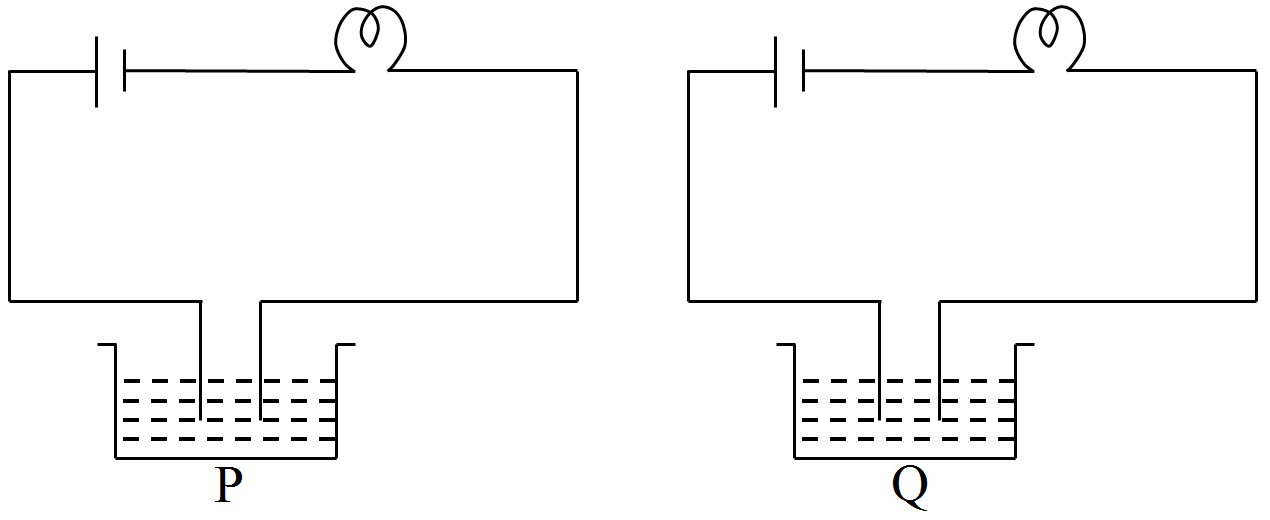
There are two different solutions in set up $P$ and $Q$ as shown in figure. The bulb in the set up $P$ glows more brightly as compared to that of the set up $Q.$ What are the possible causes for this?

$i.$ The connections of the circuit $Q$ may be loose.
$ii.$ The liquid in $Q$ may have small conductivity.
$iii.$ Liquid in $P$ is equivalent to a battery while liquid in $Q$ is equivalent to a cell of the battery of liquid $P.$
Read the given statements and select the option which correctly fill the blanks $(i) - (iv).$
$(i)$
________ is membrane bound sac filled with fluid.
$(ii)$
________ is found in cytoplasm and on endoplasmic reticulum.
$(iii)$
________ is involved in the formation of lysosome and peroxisome.
$(iv)$
________is capable of digesting any microorganism that enters the cell.
Which of the following are transferred from one object to another when these two objects are charged by friction?
Robert Hooke first observed.