MCQ
In which of the following the final image is erect?
  • Simple microscope
  • B
    Compound microscope
  • C
    Astronomical telescope
  • D
    None of these

Answer

Correct option: A.
Simple microscope

Only in simple microscope the image formed is erect, while it is inverted in compound microscope and astronomical telescope.

Need a full question paper?

Generate a complete, print-ready paper with questions like this in minutes — across 16+ boards, with answer keys.
Start Generating Free

Similar questions

A magnetic needle of magnetic moment $6.7 \times 10^{-2} Am ^2$ and moment of inertia $7.5 \times 10^{-6} \ kg \ m m ^2$ is performing simple harmonic oscillations in a magnetic field of $0.01 T$ . Time taken for $10$ complete oscillations is:
The intrinsic semiconductor becomes an insulator at
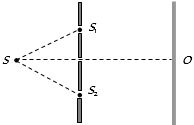
In the set up shown in Fig the two slits, ${S_1}$ and ${S_2}$ are not equidistant from the slit $S$. The central fringe at $O$ is then
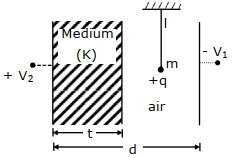
A simple pendulum of mass $'m',$ length $'I'$ and charge $'+q'$ suspended in the electric field produced by two conducting parallel plates as shown. The value of deflection of pendulum in equilibrium position will be -
For a given plate-voltage, the plate current in a triode is maximum when the potential of
An ideal coil of 10 henry is joined in series with a resistance of 5 ohm and a battery of 5 volt. 2 second after joining, the current flowing in ampere in the circuit will be
A hydrogen atom in is ground state absorbs $10.2\;eV$ of energy. The angular momentum of electron of the hydrogen atom will increase by the value of ............... $\times 10^{-34} \; J {s}$ (Given, Plank's constant $\left.=6.6 \times 10^{-34} Js \right)$
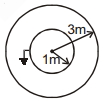
Figure shows a solid conducting sphere of radius $1 m$, enclosed by a metallic shell of radius $3 \,m$ such that their centres coincide. If outer shell is given a charge of $6 \,\mu C$ and inner sphere is earthed, find magnitude charge on the surface of inner shell is ............. $\mu C$
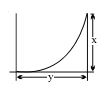
$A$ particle having charge $q$ enters a region of uniform magnetic field $\vec B$ (directed inwards) and is deflected a distance $x$ after travelling a distance $y$. The magnitude of the momentum of the particle is: 
In a regular polygon of $n$ sides, each corner is at a distance $r$ from the centre. Identical charges are placed at $(n - 1)$ corners. At the centre, the intensity is $E$ and the potential is $V$. The ratio $V/E$ has magnitude.