MCQ
In which of the following the final image is erect?
  • A
    Compound microscope
  • B
    Astronomical telescope
  • Simple microscope
  • D
    All of the above

Answer

Correct option: C.
Simple microscope

The image formed by the Compound microscope and Astronomical telescope is inverted,but in case of Simple microscope it form erect image.

Need a full question paper?

Generate a complete, print-ready paper with questions like this in minutes — across 16+ boards, with answer keys.
Start Generating Free

Similar questions

A battery of $6\, volts$ is connected to the terminals of a three meter long wire of uniform thickness and resistance of the order of $100\,\Omega $. The difference of potential between two points separated by $50\,cm$ on the wire will be .......... $V$
Two plates are 2 cm apart, a potential difference of 10 volt is applied between them, the electric field between the plates is
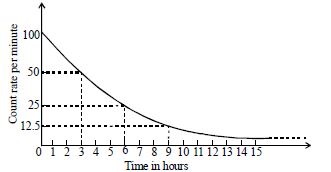
The count rate for $10\  g$ of radioactive material was measured at different times and this has been shown in the graph with scale given. The half life of the material and the total count in the first half value period respectively are
Displacement current is.
Magnification produced by astronomical telescope for normal adjustment is $10$ and length of telescope is $1.1\, m$. The magnification when the image is formed at least distance of distinct vision $(D = 25\, cm)$ is
The frequency and work function of an incident photon are n and $\phi_{0}$. If $\mathrm{n}_0$ is the threshold frequency then necessary condition for the emission of photo electron is 
The anode of a thermionic diode is connected to the negative terminal of a battery and the cathode to its positive terminal:
A coil of circular cross-section having $1000$ turns and $4 cm^2$ face area is placed with its axis parallel to a magnetic field which decreases by $10^{-2} Wb m ^{-2}$ in $0.01$ s . The $e.m.f.$ induced in the coil is:
A double convex lens $\left(\mathrm{R}_1=\mathrm{R}_2=10 \mathrm{~cm}\right)(\mu=1.5)$ having focal length equal to the focal length of a concave mirror. The radius of curvature of the concave mirror is
A monochromatic point source of light is placed at a distance $d$ from a metal surface. Photo electrons are ejected at a rate $n$ per second, and with maximum kinetic energy $E$. If the source is brought nearer to distance $d / 2$, the rate and the maximum kinetic energy per photoelectron become nearly