MCQ
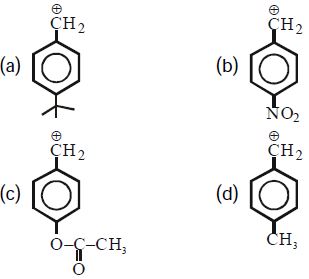
In which pair second ion is more stable than first?

- A$(i)$ and $(ii)$
- ✓$(ii)$ and $(iii)$
- C$(ii)$ and $(iv)$
- D$(iii)$ and $(iv)$
Generate a complete, print-ready paper with questions like this in minutes — across 16+ boards, with answer keys.
$(1)$ An electron in an orbital of high angular momentum stays away from the nucleus than an electron in the orbital of lower angular momentum.
$(2)$ For a given value of the principal quantum number, the size of the orbit is inversely proportional to the azimuthal quantum number
$(3)$ According to wave mechanics, the ground state angular momentum is equal to $\frac {h}{2\pi }$
$(4)$ The plot of $\Psi \,\,Vs\,\,r$ for various azimuthal quantum numbers, shows peak shifting towards higher $r$ value
$C{H_3} - CH(C{H_3}) - C{(C{H_3})_2} - C{H_2} - CH(C{H_3}) - C{H_2} - C{H_3}$
|
|
Primary |
Secondary |
Tertiary |
Quaternary |
|
$(a)$ |
$6$ |
$2$ |
$2$ |
$1$ |
|
$(b)$ |
$2$ |
$6$ |
$3$ |
$0$ |
|
$(c)$ |
$2$ |
$4$ |
$3$ |
$2$ |
|
$(d)$ |
$2$ |
$2$ |
$4$ |
$3$ |