MCQ
In which reaction racemic mixture is not obtained ?
  • A
    $CH_3-CH=CH-CH_3 + HCl \to $
  • B
    $\begin{matrix}
       Ph-CH-Cl+KCN\to   \\
       |\,\,\,\,\,\,\,\,\,\,\,\,\,\,\,\,\,\,\,\,\,\,\,\,\,\,\,\,\,  \\
       C{{H}_{3\,\,\,\,\,\,\,}}\,\,\,\,\,\,\,\,\,\,\,\,\,\,\,\,\,\,\,  \\
    \end{matrix}$
  • C
    $\begin{array}{*{20}{c}}
      {C{H_{3\,\,\,\,}} - C - Ph + HCN \to } \\ 
      {\,\,\,\,\,\,\,\,\,\,\,\,\,\,\,\,\,||\,\,\,\,\,\,\,\,\,\,\,\,\,\,\,\,\,\,\,\,\,\,\,\,\,\,\,\,\,\,\,\,\,\,\,\,\,\,} \\ 
      {\,\,\,\,\,\,\,\,\,O\,\,\,\,\,\,\,\,\,\,\,\,\,\,\,\,\,\,\,\,\,\,\,\,\,\,\,\,\,\,\,} 
    \end{array}$
  • $\begin{array}{*{20}{c}}
      {C{H_{3\,\,\,\,}} - C - Me + HCN \to } \\ 
      {\,\,\,\,\,\,\,\,\,\,\,\,\,\,\,\,\,||\,\,\,\,\,\,\,\,\,\,\,\,\,\,\,\,\,\,\,\,\,\,\,\,\,\,\,\,\,\,\,\,\,\,\,\,\,\,} \\ 
      {\,\,\,\,\,\,\,\,\,O\,\,\,\,\,\,\,\,\,\,\,\,\,\,\,\,\,\,\,\,\,\,\,\,\,\,\,\,\,\,\,} 
    \end{array}$

Answer

Correct option: D.
$\begin{array}{*{20}{c}}
  {C{H_{3\,\,\,\,}} - C - Me + HCN \to } \\ 
  {\,\,\,\,\,\,\,\,\,\,\,\,\,\,\,\,\,||\,\,\,\,\,\,\,\,\,\,\,\,\,\,\,\,\,\,\,\,\,\,\,\,\,\,\,\,\,\,\,\,\,\,\,\,\,\,} \\ 
  {\,\,\,\,\,\,\,\,\,O\,\,\,\,\,\,\,\,\,\,\,\,\,\,\,\,\,\,\,\,\,\,\,\,\,\,\,\,\,\,\,} 
\end{array}$
d

Need a full question paper?

Generate a complete, print-ready paper with questions like this in minutes — across 16+ boards, with answer keys.

Start Generating Free

Similar questions

Consider the data given below for hypothetical reaction $A \to X$

$Time  (sec)$                     Rate $(mol\,  L^{-1} sec.^{-1})$

$0$                                      $1.60 \times 10^{-2}$

$10$                                    $1.60 \times 10^{-2}$

$20$                                    $1.60 \times 10^{-2}$

$30$                                    $1.60 \times 10^{-2}$

From the above data, the order of reaction is

Among $NH_3 , PH_3 , AsH_3$ and $SbH_3$ which one is a stronger reducing agent?
Which of the following is true for given reaction 

$R - H + {X_2}\xrightarrow{{hv}}R - X + H - X$ 

If $‘a’$ is the initial concentration of the reactant, the half-life period of the reaction of $n^{t h}$ order in inversely proportional to
In the sequence of the following reactions   $C{{H}_{3}}C{{H}_{2}}OH$   $\underset{\text{ChromicAcid}}{\mathop{\xrightarrow{[\text{O }\!\!]\!\!\text{ }}}}\,X\underset{\text{ChromicAcid}}{\mathop{\xrightarrow{[O]}}}\,$    $C{{H}_{3}}COOH$ 

$X$ is

For the reaction $2A + B \to$ Product  rate law is given as $\frac{-d[A]}{dt} = K[A]$ At a time when $t = \frac{1}{K} $, concentration of the reactant is ($Co =$ initial concentration)
$pH$ of a $0.1\, M$ monobasic acid is measured to be $2$. Its osmotic pressure at a given temperature $T$ $K$ is
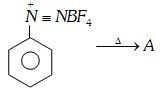
In this process product  $A $ is
Which of the following oxoacid of sulphur has $- O - O -$ linkage $?$
Three particles of a solute $A$ associate in benzene to form a trimer $A_3$ . Calculate the freezing point of $0.25$ molal solution. If the degree of association of solute $A$ is $0.80$ . The freezing point of benzene is $5.5 \,^oC$ and $K_f$ is $5.12\,\, K/m$ ? ............ $K.$