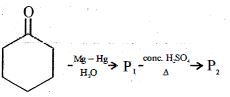
MCQ
In which solution, solubility of solute decreases with increase of temperature?
- AEthanol dissolved in water
- BGlucose dissloved in water
- CNa-Hg amalgam
- ✓Chlorine dissolved in water
Generate a complete, print-ready paper with questions like this in minutes — across 16+ boards, with answer keys.
$\frac{{ - d[A{B_5}]}}{{dt}} = K[A{B_5}]$ ; $\frac{{d[B]}}{{dt}} = {K_1}[A{B_5}]$
So the correct relation between $K$ and $K_1$ is
Assertion $(A):$ $\mathrm{H}_2 \mathrm{Te}$ is more acidic than $\mathrm{H}_2 \mathrm{~S}$.
Reason $(R):$ The bond dissociation enthalpy of $\mathrm{H}_2 \mathrm{Te}$ is less than that of $\mathrm{H}_2 \mathrm{~S}$.
In the context of the above statements, choose the correct answer from the following options:
Roasted gold ore $+CN^-+ H_2O \xrightarrow{{{O_2}}} [x] + OH^-;$ $[x] + Zn \rightarrow [y] + Au$
$[x]$ and $[y]$ are :
(ii) Silver metal does not react with $1 M$ zinc nitrate solution
(iii) Zinc metal dissolves in $1M$ copper sulphate solution and copper metal gets depositedHence the order of decreasing strength of the three metals as reducing agents will be