MCQ
In which type of molecule positive and negative charges does not coincide with each other?
  • A
    Isentropic
  • B
    Equipotential
  • Polar
  • D
    Non$-$polar

Answer

Correct option: C.
Polar
A molecule in which the centre of mass of positive and negative charges does not collide with each other is called a polar molecule. They have a permanent dipole moment. They have unsymmetrical shapes.

Need a full question paper?

Generate a complete, print-ready paper with questions like this in minutes — across 16+ boards, with answer keys.

Start Generating Free

Similar questions

Let $\mathrm{F}_{\mathrm{pp}}, \mathrm{F}_{\mathrm{pn}}$ and $\mathrm{F}_{\mathrm{nn}}$ denote the magnitudes of the net force by a proton on a proton, by a proton on a neutron and by a neutron on a neutron respectively. Neglect gravitational force. When the separation is $1 fm :$
If a wire of resistance $R$ is melted and recasted to half of its length, then the new resistance of the wire will be
When ${U^{235}}$ is bombarded with one neutron, the fission occurs and the products are three neutrons, $_{36}K{r^{94}}$ and
In Young's double slit experiment maximum intensity is $I$ then the angular position where the intensity becomes $\frac{I}{4}$ is
Match List-$I$ with List-$II$.

List-$I$ (Material) List-$II$ (Susceptibility $(x)$
$A$. Diamagnetic $I$. $\chi=0$
$B$. Ferromagnetic $II$. $ 0>\chi \geq-1$
$C$. Paramagnetic $II$I. $ x>1$
$D$. Non-magnetic $IV$. $0<\gamma<\varepsilon$ (a small positive number)

Choose the correct answer from the options given below
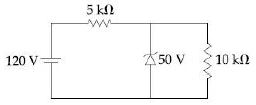
For the circuit shown below, the current through the Zener diode is......$mA$
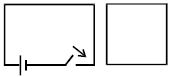
When switch is on in primary circuit then intanteneous induced current in secondary circuit is
A wire in the form of a circular loop of one turn carrying a current produces a magnetic field B at the centre. If the same wire is looped into a coil of two turns and carries the same current, the new value of magnetic induction at the centre is
P-type semiconductors are made by adding impurity element
Find the number of photons emitted per second from of source of light which results in a photocurrent with drift velocity of $1.5\ m/s$ in a conductor with cross-section area $0.25\ m^2$ , volume density of electrons $10^{20}\ per \ m^3$ , (Assume that $60\%$ of photons emitted result in electron emission)