Question
In Young’s double slit experiment, a minimum is obtained when the phase difference of super imposing waves is (a) Zero  (b) (2n – 1)π(c) nπ(d)  (n + 1) π
       

Answer

(b) (2n – 1)π

Need a full question paper?

Generate a complete, print-ready paper with questions like this in minutes — across 16+ boards, with answer keys.
Start Generating Free

Similar questions

The value of Curie temperature for Ni is nearly:
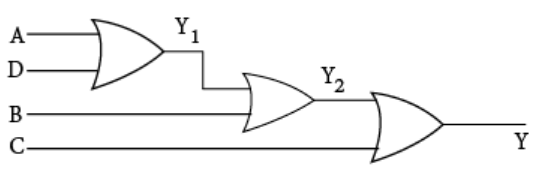
The expression of Y in the above circuit is:
The resistance of hot tungsten filament is about 10 times the cold resistance. What will be the resistance of 100 W and 200 V lamp when not in use(a) 400 Ω(b) 200 Ω(c) 40 Ω(d) 20 Ω
       
The idea of secondary wavelets for the propagation of a wave was first given by (a) Newton(b) Huygen(c) Maxwell(d) Fresnel
       
The magnetic dipole moment of a current carrying coil does not depend upon :
In comparison to a half wave rectifier, the full wave rectifier gives lower(a) Efficiency(b) Average dc(c) Average output voltage(d) None of these
   
   
Three semi-conductors are arranged in the increasing order of their energy gap as follows. The correct  arrangement is(a) Tellurium, germanium, silicon(b) Tellurium, silicon, germanium(c) Silicon, germanium, tellurium(d) Silicon, tellurium, germanium
   
   
Following operations can be performed on a capacitor:
$X -$ connect the capacitor to a battery of emf $\epsilon.$
$Y -$ disconnect the battery.
$Z -$ reconnect the battery with polarity reversed.
$W -$ insert a dielectric slab in the capacitor.
A double charged lithium atom is equivalent to hydrogen whose atomic number is $3.$ The wavelength of required radiation for emitting electron from first to third Bohr orbit in $Li^{++}$ will be $($Ionisation energy of hydrogen atom is $13.6e\ V)$
Let V and E be the gravitational potential and gravitational field at a distance r from the centre of a uniform spherical shell. Consider the following two statements:
  1. The plot of V against r is discontinuous.
  2. The plot of E against r is discontinuous.
  1. Both A and B are correct.
  2. A is correct but B is wrong.
  3. B is correct but A is wrong.
  4. Both A and B are wrong.