Question
In Young’s double slit experiment, explain with reason in each case, how the interference pattern changes, when :
  1. Width of the slits is doubled.
  2. Separation between the slits is increased.
  3. Screen is moved away from the plane of slits.
Answer

  1. The fringe width $\beta= \frac{\text{D}\lambda}{\text{d}}.$
  2. When the width of the slit is doubled; the intensity of interfering waves becomes four times, intensity of maxima becomes 16 times i.e., fringes become brighter.
  3. When separation between the slits is increased the fringe width decreases, i.e., fringes come closer.
  4. $\beta \alpha\text {D }$ when screen is moved away from the plane of the slits, the fringe width increases, i.e., fringes become farther away.

Need a full question paper?

Generate a complete, print-ready paper with questions like this in minutes — across 16+ boards, with answer keys.

Start Generating Free

Similar questions

Drive the formula of electric field for points on the equatorial plane at distance $r$ from the centre of electric dipole.
A $40\ cm$ wire having a mass of $3.2g$ is stretched between two fixed supports $40.05\ cm$ apart. In its fundamental mode, the wire vibrates at $220\ Hz$. If the area of cross-section of the wire is $1.0mm^2$, find its Young's modulus.
A tightly$-$wound, long solenoid carries a current of $2.00A$. An electron is found to execute a uniform circular motion inside the solenoid with a frequency of $1.00 \times 10^8 \ rev/s$. Find the number of turns per metre in the solenoid.
The product of the hole concentration and the conduction electron concentration turns out to be independent of the amount of any impurity doped. The concentration of conduction electrons in germanium is $6 \times 10^{19 }$ per cubic metre. When some phosphorus impurity is doped into a germanium sample, the concentration of conduction electrons increases to $2 \times 10^{23}$ per cubic metre. Find the concentration of the holes in the doped germanium.
A 10cm long rod carries a charge of $+50\mu\text{C}$ distributed uniformly along its length. Find the magnitude of the electric field at a point 10cm from both the ends of the rod.
  1. Why photoelectric effect can not be explained on the basis of wave nature of light? Give reasons.
  2. Write the basic features of photon picture of electromagnetic radiation on which Einstein’s photoelectric equation is based.
The following table gives the output of a two input logic gate.
  1. Identify the logic gate and draw its logic symbol.
  2. If the output of this gate is fed as input to a NOT gate, name the new logic gate so formed.
A
B
Y
0
0
1
1
0
1
0
1
1
1
1
0
A rod of mass m and length L, lying horizontally, is free to rotate about a vertical axis through its centre. A horizontal force of constant magnitude F acts on the rod at a distance of $\frac{\text{L}}{4}$ from the centre. The force is always perpendicular to the rod. Find the angle rotated by the rod during the time (t) after the motion starts.
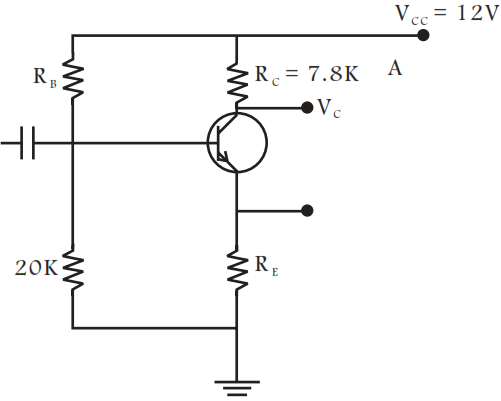
For the transistor circuit shown in Fig, evaluate $V_E, R_B, R_E$ given $I_C = 1 mA, V_{CE} = 3V, V_{BE} = 0.5 V$ and $V_{CC} = 12 V, \beta = 100.$​​​​​​​
What do you mean by colour code of carbon resistance ?