MCQ
In Young's double slit experiment, if the two slits are illuminated with separate sources, no interference pattern is observed because
  • There will be no constant phase difference between the two waves
  • B
    The wavelengths are not equal
  • C
    The amplitudes are not equal
  • D
    None of the above

Answer

Correct option: A.
There will be no constant phase difference between the two waves
a
(a)In conventional light source, light comes from a large number of independent atoms, each atom emitting light for about $10^{-9}$ sec i.e. light emitted by an atom is essentially a pulse lasting for only $10^{-9}$ sec. Light coming out from two slits will have a fixed phase relationship only for $10^{-9}$ sec. Hence any interference pattern formed on the screen would last only for $10^{-9}$ sec, and then the pattern will change. The human eye can notice intensity changes which last at least for a tenth of a second and hence we will not be able to see any interference pattern. In stead due to rapid changes in the pattern, we will only observe a uniform intensity over the screen.

Need a full question paper?

Generate a complete, print-ready paper with questions like this in minutes — across 16+ boards, with answer keys.

Start Generating Free

Similar questions

$\begin{matrix}
   O\,\,\,\,\,\,\,\,\,  \\
   ||\,\,\,\,\,\,\,\,\,\,  \\
   C{{H}_{3}}C{{H}_{2}}-C-C{{H}_{3}}\xrightarrow[HCl]{NaN{{O}_{2}}};  \\
\end{matrix}$ Major product of this reaction is
An insulated container contains $4\, moles$ of an ideal diatomic gas at temperature $T$. Heat $Q$ is supplied to this gas, due to which $2\, moles$ of gas are dissociated into  atoms but temperature of the gas remains constant. Then:
The decay of a proton to neutron is :
A square of side $x\, m$ lies in the $x-y$ plane in a region, where the magnetic field is given by $\vec B = B_0 (3\hat i + 4\hat j + 5\hat k )\,T$, where $B_0$ is constant. The magnitude of flux passing through the square is
To accommodate the view that matter is made up to $5$ elements only, a scientist proposed the following hypothesis; that atoms can have a maximum principal quantum number $n _{\operatorname{man}}$ and no higher. Then, which of the following statements must be true ?
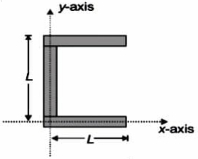
Locate the centre of mass of arrangement shown in figure. The three rods are identical in mass and length
Two convex lenses of focal lengths $0.3 \,m$ and $0.05 \,m$ are used to make a telescope. The distance kept between the two is....$m$
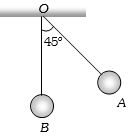
The bob $A$ of a simple pendulum is released when the string makes an angle of ${45^o}$with the vertical. It hits another bob $B$ of the same material and same mass kept at rest on the table. If the collision is elastic
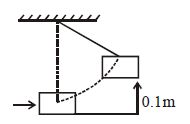
A bullet of mass $0.01\, kg$ and travelling at a speed of $500\, m/s$ strikes and passes horizontally through a block of mass $2\,kg$ which is suspended by string of string of length $5\,m$. The centre of gravity of the block is found to raise a vertical distance of $0.1\,m$. What is the speed of the bullet after it emerges from the block .......... $\mathrm{m}/ \mathrm{s}$ $[g = 9.8\,m/s^2]$ (time of passing of bullet is negligible)
$A$ in the above reaction is: