Question

In Young's double slit experiment, if the two slits are illuminated with separate sources, no interference pattern is observed because

(a) There will be no constant phase difference between the two waves

(b) The wavelengths are not equal

(c) The amplitudes are not equal

(d) None of the above

Answer

(a) There will be no constant phase difference between the two waves

Need a full question paper?

Generate a complete, print-ready paper with questions like this in minutes — across 16+ boards, with answer keys.

Start Generating Free

Similar questions

The kinetic energy of an electron with de-Broglie wavelength of 0.3 nanometer is

(a) 0.168 eV

(b) 16.8 eV

(c) 1.68 eV

(d) 2.5 eV

A steady current i flows in a small square loop of wire of side L in a horizontal plane. The loop is now folded about its middle such that half of it lies in a vertical plane. Let   and   respectively denote the magnetic moments due to the current loop before and after folding. Then

(a)  

(b)  and   are in the same direction

(c)  

(d)  

The relation among u, v and f for a mirror is:

Four resistances 10 W, 5 W, 7 W and 3 W are connected so that they form the sides of a rectangle AB, BC, CD and DA respectively.  Another resistance of 10 W is connected across the diagonal AC. The equivalent resistance between A and B is

(a) 2 W    

(b) 5 W

(c) 7 W    

(d) 10 W

The drift velocity does not depend upon

(a) Cross-section of the wire

(b) Length of the wire

(c) Number of free electrons

(d) Magnitude of the current

The function of rectifier is :

What will be the ratio of de-Broglie wavelengths of proton and α - particle of same energy

(a) 2 : 1

(b) 1 : 2

(c) 4 : 1

(d) 1 : 4

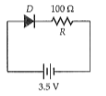
In the given figure, a diode D is connected to an external resistance $R =100 \Omega$ and an emf of 3.5 V . If the barrier potential developed across the diode is 0.5 V , the current in the circuit will be
Image
‘X’ is a type of commercial resistor made from a mixture of clay, carbon black, and resin binder which are pressed and then molded into cylindrical rods by heating. Identify X.

If the potential of a capacitor having capacity of 6 mF is increased from 10 V to 20 V, then increase in its energy will be

(a) 12 × 10–6 J

(b) 9 × 10⁻⁴ J

(c) 4 × 10⁻⁶ J

(d) 4 × 10⁻⁹ J