Question

In Young’s double slit experiment, the central bright fringe can be identified

(a) By using white light instead of monochromatic light

(b) As it is narrower than other bright fringes

(c) As it is wider than other bright fringes

(d) As it has a greater intensity than the other bright fringes

Answer

(a) By using white light instead of monochromatic light

Need a full question paper?

Generate a complete, print-ready paper with questions like this in minutes — across 16+ boards, with answer keys.

Start Generating Free

Similar questions

Curie temperature is the temperature above which:
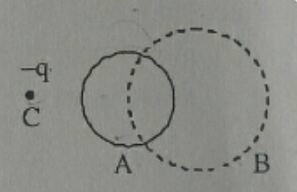
In the figure shown here, A is a conducting sphere and B is a closed spherical surface. If a-q change is placed at C near A, then the electric flux through the closed surface is -

Refer to the arrangement of charges in Fig. and a Gaussian surface of radius R with Q at the centre. Then:

A coil of self inductance 50 henry is joined to the terminals of a battery of e.m.f. 2 volts through a resistance of 10 ohm and a steady current is flowing through the circuit. If the battery is now disconnected, the time in which the current will decay to 1/e of its steady value is

(a) 500 seconds

(b) 50 seconds

(c) 5 seconds

(d) 0.5 seconds

The primary origin (s) of magnetism lies in:

The magnetic induction at any point due to a long straight wire carrying a current is

(a) Proportional to the distance from the wire

(b) Inversely proportional to the distance from wire

(c) Inversely proportional to the square of the distance from the wire

(d) Does not depend on distance

The electric potential decreases uniformly from 120V to 80V as one moves on the x-axis from x = -1cm to x = + 1cm. The electric field at the origin.
Which of the following is not according to addition law of binary digits ?
The wavelength $\lambda$, frequency $v$, velocity $v$ and intensity I of a light ray transmitted in air respectively. If this ray enters water, then the values of these quantities become $\lambda^{\prime}, \nu^{\prime}, v^{\prime}$ and $I^{\prime}$ respectively. Which of the following relations is correct?

A metal surface of work function 1.07 eV is irradiated with light of wavelength 332 nm. The retarding potential required to stop the escape of photo-electrons is

(a) 4.81 eV

(b) 3.74 eV

(c) 2.66 eV

(d) 1.07 eV