Question

In Young's double slit experiment, the intensity on the screen at a point where path difference is l is K. What will be the intensity at the point where path difference is λ/4

(a)  

(b)  

(c) K 

(d) Zero

Answer

(b)  

Need a full question paper?

Generate a complete, print-ready paper with questions like this in minutes — across 16+ boards, with answer keys.

Start Generating Free

Similar questions

Assertion :   In meter bridge experiment, a high resistance is always connected in series with a galvanometer.

Reason     : As resistance increases current through the circuit increases.

(a) If both assertion and reason are true and the reason is the correct explanation of the assertion.

(b) If both assertion and reason are true but reason is not the correct explanation of the assertion.

(c) If assertion is true but reason is false.

(d) If the assertion and reason both are false.

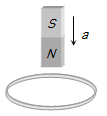
A metallic ring is attached with the wall of a room. When the north pole of a magnet is brought near to it, the induced current in the ring will be

(a)  First clockwise then anticlockwise

(b)  In clockwise direction

(c)  In anticlockwise direction

(d)  First anticlockwise then clockwise

Five balls numbered 1 to 5 are suspended using separate threads. Pairs (1, 2), (2, 4) and (4, 1) show electrostatic attraction, while pair (2, 3) and (4, 5) show repulsion. Therefore ball 1 must be

(a) Positively charged

(b) Negatively charged

(c) Neutral

(d) Made of metal

A transformer has turn ratio 100/1. If secondary coil has 4 amp current then current in primary coil is

(a) 4 A

(b) 0.04 A

(c) 0.4 A  

(d) 400 A

Two lithium nuclei in a lithium vapour at room temperature do not combine to form a carbon nucleus because:
  1. A lithium nucleus is more tightly bound than a carbon nucleus.
  2. Carbon nucleus is an unstable particle.
  3. It is not energetically favourable.
  4. Coulomb repulsion does not allow the nuclei to come very close.

The attenuation in optical fibre is mainly due to

(a) Absorption

(b) Scattering

(c) Neither absorption nor scattering

(d) Both (a) and (b)

Assertion :  The energy of charged particle moving in a uniform magnetic field does not change.

Reason    : Work done by magnetic field on the charge is zero.

(a) If both assertion and reason are true and the reason is the correct explanation of the assertion.

(b) If both assertion and reason are true but reason is not the correct explanation of the assertion.

(c) If assertion is true but reason is false.

(d) If the assertion and reason both are false.

When $p-n$ junction is kept in forward bias, __________ .
The radio of deBroglie wavelengths of a proton and an alpha particle of same energy is:
When the velocity of an electron increases, its de Broglie wavelength: