Question
In Young's double slit experiment, the phase difference between the light waves reaching third bright fringe from the central fringe will be (λ =6000 Å )(a) Zero(b) 2π(c) 4 π(d) 6 π
       

Answer

(d) 6 π

Need a full question paper?

Generate a complete, print-ready paper with questions like this in minutes — across 16+ boards, with answer keys.
Start Generating Free

Similar questions

The molecules having permanent electric dipole moment even in the absence of electric field are called as:
ike magnetic force ______ each other.
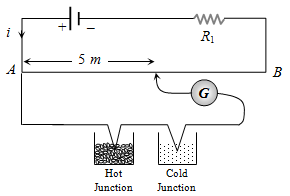
In the following circuit a $10 m$ long potentiometer wire with resistance $1.2 \ \text{ohm/m},$ a resistance $R_1$ and an accumulator of emf $2 V$ are connected in series. When the $\text{emf}$ of thermocouple is $2.4 \ \text{mV}$ then the deflection in galvanometer is zero. The current supplied by the accumulator will be
A white screen illuminated by green and red light appears to be(a) Green  (b) Red(c) Yellow(d) White
       
If in a photoelectric experiment, the wavelength of incident radiation is reduced from 6000 Å to 4000 Å then(a) Stopping potential will decrease(b) Stopping potential will increase(c) Kinetic energy of emitted electrons will decrease(d) The value of work function will decrease


Rydberg’s constant is:
Kinetic energy with which the electrons are emitted from the metal surface due to photoelectric effect is (a) Independent of the intensity of illumination(b) Independent of the frequency of light(c) Inversely proportional to the intensity of illumination(d) Directly proportional to the intensity of illumination


An electric field is applied to a semiconductor. Let the number of charge carriers be $n$ and the average drift speed be $v.$ If the temperature is increased,
Two resistances are connected in two gaps of a metre bridge. The balance point is 20 cm from the zero end. A resistance of 15 ohms is connected in series with the smaller of the two. The null point shifts to 40 cm. The value of the smaller resistance in ohms is(a) 3 (b) 6(c) 9  (d) 12
       
In the case of bar magnet, lines of magnetic induction(a) Start from the north pole and end at the south pole(b) Run continuously through the bar and outside(c) Emerge in circular paths from the middle of the bar(d) Are produced only at the north pole like rays of light from a bulb