MCQ
In Young's double slit interference experiment, the slit separation is made $3 $ fold. The fringe width becomes
  • $1/3$ times
  • B
    $1/9$ times
  • C
    $3 $ times
  • D
    $9$ times

Answer

Correct option: A.
$1/3$ times
a
(a)$\beta \propto \frac{1}{d}$==> If $d$  becomes thrice, then $\beta $ become becomes $\frac{1}{3}$ times.

Need a full question paper?

Generate a complete, print-ready paper with questions like this in minutes — across 16+ boards, with answer keys.

Start Generating Free

Similar questions

The equation of stationary wave along a stretched string is given by $y = 5\sin \frac{{\pi x}}{3}\cos 40\pi t$, where $x $ and $y$ are in $cm$ and $t$ in second. The separation between two adjacent nodes is..... $cm$
A modern grand-prix racing car of mass $m$ is travelling on a flat track in a circular arc of radius $R$ with a speed $v$. If the coefficient of static friction between the tyres and the track is $\mu_{s},$ then the magnitude of negative lift $F_{L}$ acting downwards on the car is

(Assume forces on the four tyres are identical and $g =$ acceleration due to gravity)
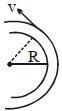
A wire bent in the shape of a regular $n$-polygonal loop carries a steady current $I$. Let $l$ be the perpendicular distance of a given segment and $R$ be the distance of a vertex both from the centre of the loop. The magnitude of the magnetic field at the centre of the loop is given by
If $'f^{\prime}$ denotes the ratio of the number of nuclei decayed $\left(N_{d}\right)$ to the number of nuclei at $t=0$ $\left({N}_{0}\right)$ then for a collection of radioactive nuclei, the rate of change of $'f'$ with respect to time is given as:

$[\lambda$ is the radioactive decay constant]
A parallel plate capacitor is charged to $60\,\mu C$. Due to a radioactive source, the plate loses charge at the rate of $1.8 \times 10^{-8}\, C/s$. the magnitude of displacement current is
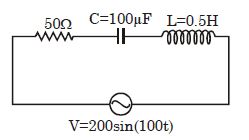
In the given $LCR$  $AC$ circuit, the effective current flowing through the circuit will be.....$A$
An object of mass $80 \,kg$ moving with velocity $2 \,ms ^{-1}$ hit by collides with another object of mass $20 \,kg$ moving with velocity $4 \,ms ^{-1}$. Find the loss of energy assuming a perfectly inelastic collision ........... $J$
A solid cylinder of radius $R$ and mass $M$, rolls down on inclined plane without slipping and reaches the bottom with a speed $v$. The speed would be less than $v$ if we use
Two spherical conductors $B$ and $C$ having equal radii and carrying equal charges in them repel each other with a force $F$ when kept apart at some distance. A third spherical conductor having same radius as that of $B$ but uncharged is brought in contact with $B$, then brought in contact with $C$ and finally removed away from both. The new force of repulsion between $B$ and $C$ is
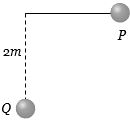
A pendulum of length $2\,m$ lift at $P$. When it reaches $Q$, it losses $10\%$ of its total energy due to air resistance. The velocity at $Q$ is .... $m/sec$